
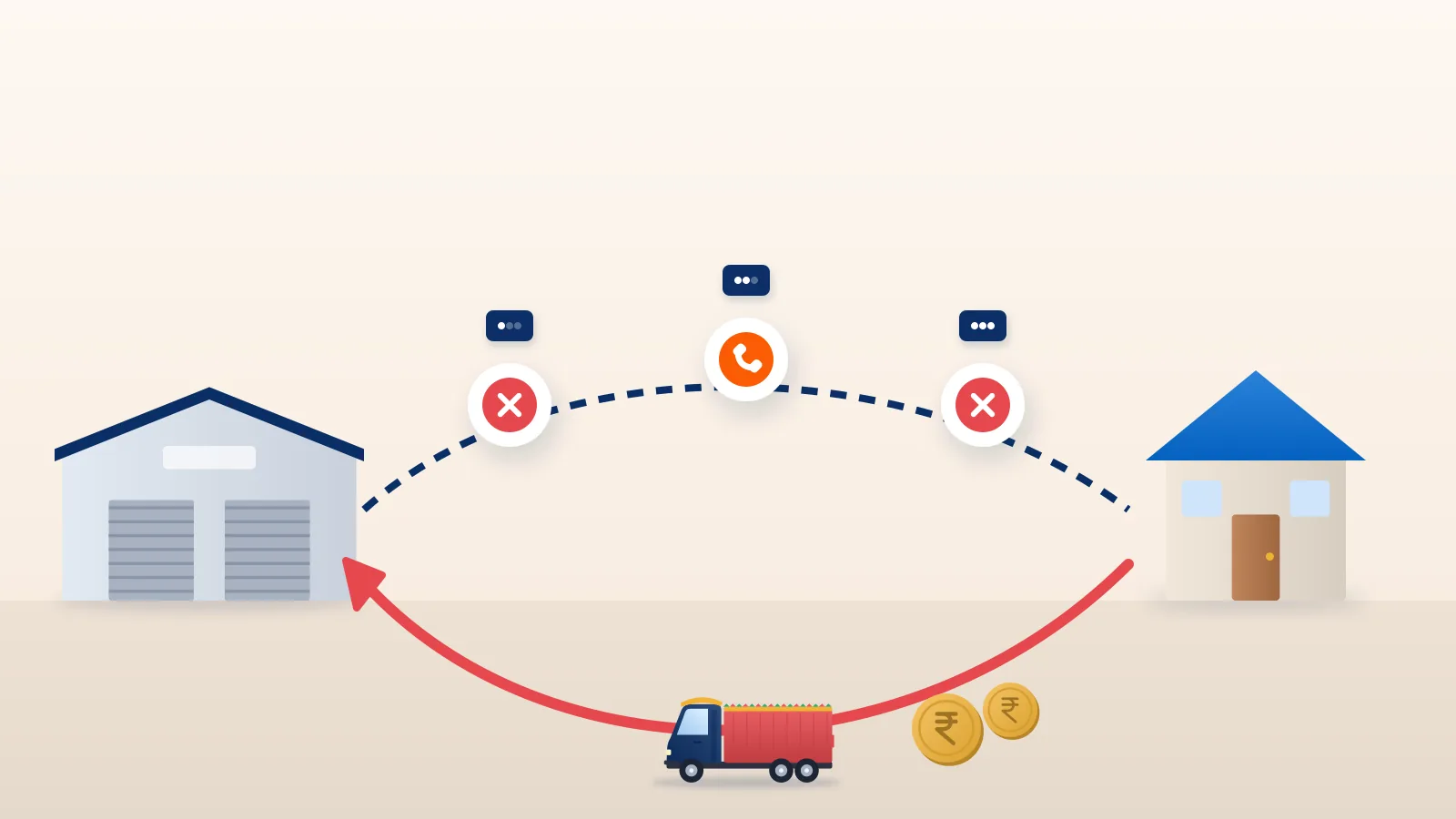
If you sell online in India, two abbreviations show up in your dashboard every week: NDR and RTO. An NDR means a delivery attempt failed. An RTO means the parcel is coming back to you. Every RTO costs you freight twice and earns you nothing, so understanding the path from one to the other is one of the most direct ways to protect your margins.
This guide explains both terms, the usual reasons deliveries fail, what an RTO costs, and what you can do before and after dispatch to reduce them.
What is NDR in courier?
NDR stands for non-delivery report. The courier raises it when a delivery executive attempts a shipment and cannot complete it. Delhivery’s help centre, for example, describes NDR as “orders that were attempted but undelivered/not-picked”, which covers both forward deliveries and reverse pickups.
An NDR is not the end of the order. The parcel is still with the courier, usually at the local delivery hub. It is a signal that you need to act: confirm the buyer’s details and ask for another attempt, or decide to take the parcel back.
What is RTO in ecommerce?
RTO stands for return to origin. The shipment is not delivered and travels back to your pickup address (your “origin”). Delhivery’s help centre describes RTO as a sale order that was undelivered and returned to the client warehouse.
RTO can happen for a few reasons:
- delivery attempts run out after repeated NDRs
- the buyer refuses the parcel at the door
- you cancel the order while it is already in transit
How a failed attempt turns into an RTO
The typical path looks like this:
- The parcel goes out for delivery.
- The attempt fails and the courier records a reason, for example “customer not available”.
- An NDR appears in your shipping dashboard.
- You (or the buyer) act: request a reattempt, correct the address or phone, or choose to return the parcel.
- The courier attempts again.
- If the final allowed attempt also fails, the shipment is marked RTO and starts its journey back.
The number of attempts is set by each courier and can change. At the time of writing (October 2026):
| Courier | What its official page says |
|---|---|
| Delhivery | Forward deliveries can be reattempted three times. If the third attempt fails, the status changes from “Out for Delivery” to “RTO”. Reverse pickups can be rescheduled at most three times. |
| Amazon Shipping (India) | Its small and medium delivery page lists three delivery attempts before the RTO process starts. |
For other couriers, check their current terms or ask your shipping platform. Do not assume every courier waits the same length of time between attempts, or that it will hold a parcel for you indefinitely. The safe habit is to act on every NDR the same day.
Common reasons for NDR
Courier reason labels vary, but most NDRs fall into a handful of groups. We have grouped them by who can fix them.
| Reason | What usually happened | Who can fix it |
|---|---|---|
| Customer not available | Nobody home or at the office during the attempt | Buyer (confirm a time), you (reattempt) |
| Phone unreachable or switched off | The delivery executive could not call ahead or find the house | Buyer (alternate number), you (update phone) |
| Incomplete or wrong address | Missing house number, no landmark, wrong pincode | Buyer (correct details), you (update address) |
| Customer refused | Changed mind, ordered by mistake, expected something different | Buyer; often ends in RTO |
| COD amount not ready | Buyer did not have cash or the exact amount | Buyer (reschedule) |
| Premises closed | Shop, office or gated society closed or entry refused | Buyer (alternate time or address) |
| Buyer asked for a later date | Travelling or busy | You (reschedule with the courier) |
| Out of delivery area or entry restrictions | Pincode or location not reachable that day | You (check serviceability before booking) |
Some of these are genuinely the buyer’s choice. Many are information problems you can prevent before the parcel leaves your shelf.
What an RTO costs you
Each RTO hits you in several places at once:
- Forward freight. You paid to send the parcel out. That money is gone.
- Return freight. Couriers commonly charge for the return trip too. Check the RTO line in your rate card. Delhivery’s rate card, for example, notes that its destination city surcharge applies to RTO shipments as well as forward and reverse ones.
- COD charges. For COD orders you may have paid a COD fee. How this is treated on an RTO (refunded, partly refunded or kept) depends on your courier or platform terms. Check before you assume.
- Packaging and labour. The box, filler and packing time are usually lost. Returned parcels often need repacking.
- Blocked stock. The item is in transit for days and cannot be sold. For seasonal or limited stock, this can mean a missed sale.
- Damage risk. Returned parcels are handled twice as often, so check them on arrival.
A hypothetical example
These numbers are made up and rounded to show the maths. They are not any courier’s rates.
| Line | Delivered order | RTO order |
|---|---|---|
| Forward freight | ₹60 | ₹60 |
| COD charge (if not refunded) | ₹30 | ₹30 |
| Return freight | – | ₹60 |
| Packaging | ₹15 | ₹15 (plus repack) |
| Shipping-side cost | ₹105 | ₹165 |
| Revenue | Order value | ₹0 |
In this example, the RTO costs ₹165 and brings in nothing. The delivered order cost ₹105 and earned the sale. If, say, one in ten of your COD orders came back (again, a hypothetical figure), the other nine would need to cover those losses. Use your own rate card and order mix to run this calculation. Our shipping rate calculator can give indicative forward charges to start from.
What to do when you get an NDR
Speed matters most. The attempt window is short, and every day a parcel sits at a hub brings it closer to the final attempt.
- Check the reason and attempt count. Open the NDR and note what the courier recorded and how many attempts are left.
- Contact the buyer. A short call or message from your own number works better than waiting for the courier. Confirm they still want the order, the right address and landmark, a reachable phone number and a good time.
- Update the details. If the address or phone was wrong, update it through your shipping dashboard where the courier allows it.
- Request a reattempt or reschedule. Ask for the next attempt on the date the buyer gave you.
- Choose return when it makes sense. If the buyer clearly does not want the parcel, asking for a return early can save attempts and days of blocked stock. Delhivery’s NDR page, for example, lets sellers either reattempt or return a forward shipment.
- Log the outcome. Note the reason and result. You will use this in your weekly review.
Aim to act the same day the NDR appears. Leaving it until the next day can mean the next attempt has already happened without any new information.
How to reduce RTO before dispatch
Most RTO prevention happens before you print the label.
Address quality
- Validate the pincode against the city and state the buyer entered. A mismatch is a red flag.
- Ask for a landmark at checkout and make it a required field if your store platform allows it.
- Check for incomplete addresses. An address with only a locality name, or no house or flat number, should be confirmed before booking.
- Confirm the phone number. A valid 10-digit mobile number the buyer actually answers is the single most useful thing a delivery executive can have.
Confirm COD orders
For COD orders, a quick confirmation call or message before booking catches orders placed by mistake, duplicate orders and buyers who are no longer interested. Cancelling before dispatch costs you nothing in freight. Cancelling through an RTO costs you twice.
Hold unconfirmed COD orders for a short, fixed time, then follow your own rule: cancel, or ship with extra care.
Set clear delivery expectations
Show a realistic delivery estimate on the product page and in the order confirmation. Buyers who know when to expect a parcel are more likely to be available and to have cash ready for COD. Share the tracking link as soon as the AWB is generated. Buyers can check status on our tracking page too.
Make product pages accurate
Refusals often come from buyers who expected something different. Clear photos, correct sizes and colours, honest descriptions and visible return terms reduce “changed my mind” refusals at the door.
Package properly
A damaged or tampered-looking box gives the buyer a reason to refuse. Use a box that fits the product, enough padding and a tamper-evident seal. Proper packaging also helps avoid weight disputes. See our guide on courier weight disputes.
Check pincode serviceability
Before you accept or book an order, confirm the pincode is serviceable for the courier and the payment mode. A pincode can be served for prepaid but not COD, or only by certain couriers. Our free pincode serviceability checker lets you check quickly.
Prepaid vs COD: how payment mode affects RTO
COD orders are generally more exposed to RTO than prepaid orders. The reasons are practical rather than statistical:
- The buyer has not committed any money, so cancelling at the door costs them nothing.
- The buyer needs cash, or a payment option, ready at the time of delivery.
- Impulse and duplicate orders are easier to place when nothing is paid upfront.
Prepaid orders can still fail, mostly because of address or availability problems, but a refusal is less common because the buyer has already paid.
You do not have to stop offering COD to reduce RTO. Practical options include:
- encouraging prepaid with a clear, honest incentive
- confirming COD orders before booking
- limiting COD for very high-value orders or for pincodes where you see repeated returns
COD also carries its own charge. For example, at the time of writing Amazon Shipping India lists its COD charge as ₹30 per parcel or 1.5% of product value, whichever is higher. Other couriers price COD differently. Factor this into your COD vs prepaid decision. Any change to payment terms or incentives should follow your store’s published policies, so confirm with your adviser if unsure.
A weekly NDR and RTO review routine
A 30-minute review once a week will show you where your failed deliveries come from.
- Export last week’s NDRs and RTOs from your shipping dashboard.
- Group them by reason. Address, phone, refused, not available, COD not ready, and so on.
- Group them by pincode and city. Look for clusters that keep repeating.
- Group them by payment mode and courier. Compare COD and prepaid, and each courier on the same lanes.
- Check response time. How many NDRs did you act on the same day? How many turned into RTO with no action?
- Pick one fix for the coming week. For example, make the landmark field mandatory, add COD confirmation for a city, or try a different courier for a set of pincodes.
- Inspect returned parcels. Check them for damage, restock them and update inventory.
NDR and RTO checklist
- Pincode matches city and state before booking
- Address has house or flat number and a landmark
- Phone number is valid and reachable
- COD order confirmed with the buyer
- Pincode is serviceable for the courier and payment mode
- Delivery estimate and tracking link shared with the buyer
- Parcel packed securely with a tamper-evident seal
- Every NDR actioned the same day
- Weekly review done and one fix chosen
Managing NDR and RTO in Courier Tales
Courier Tales is a shipping platform for Indian online sellers. Failed delivery attempts are listed as NDRs so you can act on them. RTO shipments stay visible until they reach your pickup address. Reverse pickups are available with Delhivery in eligible pincodes. You can also check serviceability and compare couriers per order before booking. To read more, see our guides on choosing a courier aggregator and e-commerce shipping.
Ready to try it? Create a Courier Tales account.
Frequently asked questions
What is the difference between NDR and RTO?
An NDR is raised when a delivery attempt fails and the parcel is still with the courier. RTO is what happens when the shipment is finally sent back to your pickup address instead of being delivered.
How many delivery attempts do couriers make before RTO?
It depends on the courier. At the time of writing, Delhivery's help centre says a forward shipment can be reattempted three times, and Amazon Shipping India advertises three delivery attempts before RTO starts. Check your courier's current terms.
Do I pay shipping charges on an RTO?
Usually yes. You have already paid for the forward trip, and couriers commonly charge for the return leg as well. Check your rate card for the RTO charge and how COD charges are treated on returned parcels.
Can I stop an RTO once it has started?
Usually not. Once a courier marks a shipment as RTO, it normally travels back to you, so check your courier's terms. That is why acting on the NDR before the final attempt matters.
Sources
- Non-Delivery Report (NDR), Delhivery One Help Center (accessed 19 October 2026)
- Exceptions & Non-Delivery Report (NDR), Delhivery One Help Center (accessed 19 October 2026)
- Courier Return/Return to Origin, Delhivery One Help Center (accessed 19 October 2026)
- Rate Card, Delhivery One Help Center (accessed 19 October 2026)
- Small and medium delivery, Amazon Shipping India (accessed 19 October 2026)
Courier, marketplace and tax rules change. Check the current terms with your courier, marketplace or adviser before relying on them.