
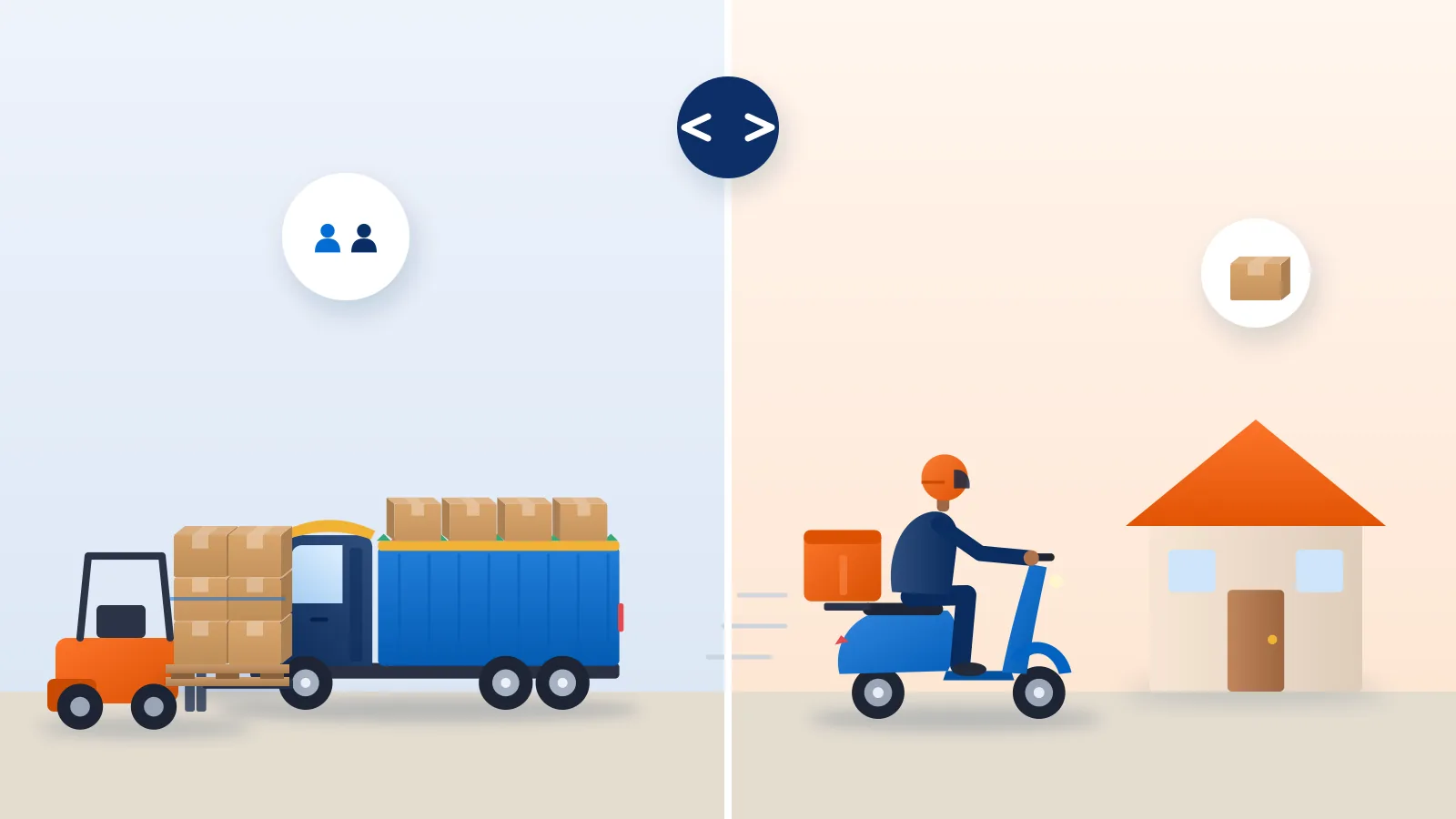
A wholesaler in Surat might pack fifty single sarees for buyers across India in the morning, then load twelve cartons for a retailer in Lucknow after lunch. Both jobs are “shipping”, but they behave very differently. The rate card is different, the box is different, the paperwork is different, and the delivery person at the other end is facing a shop counter instead of a front door.
This guide explains where B2B and B2C shipping differ, the mistakes sellers make when they treat them the same way, and how to run both from one operation.
What B2B and B2C shipping mean
B2C (business to consumer) shipping is what most online sellers do every day: one order, usually one parcel, sent to an individual at a home or office address. Weights are typically a few hundred grams to a few kilograms.
B2B (business to business) shipping moves goods to another business: a retailer restocking shelves, a distributor buying in bulk, a dealer in another state, or your own stock moving to a warehouse. Consignments are heavier, often split across several boxes, and the buyer usually pays on an invoice rather than at the door.
Many growing brands do both. A D2C skincare label selling on its own website (B2C) may also supply salons and pharmacies (B2B). If you are building that kind of brand, our guide to D2C shipping in India covers the consumer side.
The differences side by side
| Factor | B2C shipping | B2B shipping |
|---|---|---|
| Typical shipment | One small parcel per order | Several cartons or a heavy single consignment |
| Who receives it | An individual at home or work | A shop, warehouse, office or factory |
| Pricing basis | Weight slabs per parcel, by zone | Per kg with a minimum chargeable weight or minimum charge per consignment |
| Payment | Prepaid or cash on delivery | Invoice with credit terms, or advance payment |
| Packaging | Retail-ready box or mailer | Shipping cartons, sometimes strapped or palletised |
| Delivery window | Any time the buyer is reachable | Business hours; some receivers need an appointment |
| Paperwork | Invoice in the parcel; e-way bill only above the value threshold | Tax invoice, e-way bill more often, packing list, consignment note |
| Returns | Individual returns and exchanges | Shortage, damage and quantity disputes |
| Proof of delivery | Delivery scan, sometimes OTP | Signed and stamped proof of delivery is often expected |
The table is a general picture. Individual couriers and freight carriers set their own rules, so read the terms of the service you book.
Pricing: why the cheaper-looking rate can cost more
B2C parcels are usually priced in weight slabs (for example, the first 500 g and each additional 500 g) that change with the delivery zone. Couriers charge on the chargeable weight, the higher of the actual weight and the volumetric weight worked out from the box size. Our explainer on volumetric weight and shipping charges covers the maths.
B2B freight services often quote a lower rate per kilogram, but with conditions:
- Minimum chargeable weight. A consignment may be billed at a minimum weight even if it is lighter. Two small cartons can end up costing more by freight than by parcel.
- Volume conversion. Freight carriers convert volume into weight using a factor printed on their rate card. Check it, because it may differ from the factor used for parcels.
- Extra charges. Docket charges, handling for heavy pieces, delivery to out-of-delivery-area pincodes, appointment delivery, and storage if the receiver does not accept the goods can all apply. Carriers list these differently, so compare the total, not the base rate.
An illustration
Say Ritu, who runs a home-décor brand in Jaipur, gets a restock order of 40 cushion covers from a boutique in Pune. Packed in one carton, the consignment weighs 9 kg. As a parcel, she would pay the parcel rate for 9 kg. As freight, she might pay a lower per-kg rate but be billed at the carrier’s minimum weight. Which is cheaper depends entirely on the two rate cards. The only reliable method is to price the actual consignment both ways before booking. (This is an illustration; no rates are quoted.)
Packaging is a different job
B2C packaging protects one product and creates a decent unboxing. B2B packaging has to survive being stacked, loaded and unloaded several times with other freight.
For B2B consignments:
- Use corrugated cartons rated for the weight, not retail mailers.
- Pack evenly so cartons do not crush when stacked.
- Mark every carton with “Box 1 of 4”, “Box 2 of 4” and so on, plus the consignee name and invoice number.
- Put a packing list inside the first carton and keep a copy.
- For several cartons going to one receiver, ask whether the carrier wants them strapped together or palletised.
A carton count on the label is the simplest protection against a common B2B complaint: “We received three boxes, not four.”
Paperwork: the e-way bill and the rest
GST rules apply to both, but B2B consignments run into document requirements more often because their value is higher.
According to the official e-way bill system, an e-way bill is generated electronically for the movement of goods worth more than Rs 50,000. It covers B2C consignments too, but a single consumer parcel rarely crosses that value, while a wholesale order often does. Some states use different limits for movement within the state. The e-way bill has two parts: Part A carries the invoice and goods details, and Part B the vehicle or transporter details. Once generated, it cannot be edited; it can only be cancelled within 24 hours and generated again.
A typical B2B consignment travels with:
- A tax invoice (with the buyer’s GSTIN where applicable).
- An e-way bill if the value requires one.
- A packing list showing items per carton.
- The carrier’s consignment note or docket.
Tax rules have conditions and exceptions. Confirm your obligations with a chartered accountant, especially for inter-state movement and stock transfers between your own locations.
Delivery and proof of delivery
A consumer can take a parcel at the gate in thirty seconds. A business receiver may only accept goods during working hours, at a loading area, after checking the count against the invoice. Large-format retailers and warehouses often ask for delivery appointments.
That changes what you should expect from a shipment:
- Transit time. B2B freight may need more days than a parcel on the same route, because consignments are consolidated and handled differently.
- Failed deliveries. “Shop closed” and “receiver refused, appointment needed” are common B2B reasons. Share your receiver’s working hours and a contact person when you book.
- Proof of delivery. Ask the receiver to note any damage or shortage on the delivery document before signing. Without that note, a later claim is hard to make.
Returns and disputes
In B2C, a return usually means one buyer changed their mind or got the wrong size. Our guide to NDR and RTO in ecommerce covers undelivered consumer parcels.
In B2B, the disputes are about quantity and condition. Photograph cartons before dispatch, record weights, keep the packing list, and get damage noted on delivery. These records settle most arguments with both the buyer and the carrier.
Running B2B and B2C from one operation
Most small brands cannot afford two separate logistics teams. A few habits keep both streams under control:
- Separate the queues. Process consumer orders and business consignments as different batches, with different packing materials and checklists.
- Price both modes. For consignments of moderate weight, perhaps 10 to 30 kg, compare the parcel and freight options before booking. The crossover point depends on your rate cards and lanes.
- Keep one view of everything. Track B2B consignments and B2C parcels where you can see them together, so a stuck wholesale order does not get lost under a hundred consumer parcels.
On Courier Tales, B2C orders can be imported from Shopify or WooCommerce or uploaded from a spreadsheet, and you compare the integrated couriers that serve each route with estimated charges before booking.
Shipping to shops and distributors as well as consumers? Courier Tales also handles B2B shipments; ask our team about your lanes.
If you are moving heavier stock regularly, our cargo shipping guide for India explains road, rail, air and sea options, and the comparison of air cargo and surface cargo helps you pick a mode.
A quick decision checklist
Before you book any shipment, answer these:
- Is the receiver a person or a business?
- How many boxes, and what is the total chargeable weight?
- Does the value need an e-way bill?
- Is the payment prepaid, COD or on invoice?
- Does the receiver have fixed hours or need an appointment?
- What proof of delivery will you need if something goes wrong?
Final thoughts
B2B and B2C shipping are not better or worse than each other. They are different jobs with different costs. Sellers lose money when they book a wholesale order like a consumer parcel, or a single parcel through a freight service with a minimum charge. Price each consignment the way it will actually be billed, pack it for the journey it will actually take, and keep the documents that let you settle disputes.
When you are ready to manage consumer parcels and business consignments with less manual work, create your Courier Tales account and talk to our team about your B2B lanes.
Frequently asked questions
What is the main difference between B2B and B2C shipping?
B2C shipping sends small parcels to individual buyers, usually one order and one box at a time. B2B shipping sends larger, often multi-box consignments to other businesses such as retailers, distributors or warehouses. The two differ in how they are priced, packed, documented and delivered.
Can I use the same courier for B2B and B2C orders?
Sometimes. Some couriers run separate parcel and freight services, with different rate cards and booking rules. Compare the service meant for each type of shipment rather than forcing a 60 kg wholesale order through a parcel service.
Do B2B shipments need an e-way bill?
Under the GST e-way bill rules, an e-way bill is generally needed when goods worth more than Rs 50,000 move in a consignment, whether the buyer is a business or a consumer. B2B consignments cross that value more often. Some states set different limits for movement within the state, so confirm with your CA.
Is cash on delivery used for B2B shipments?
It is uncommon. Business buyers usually pay against an invoice on agreed credit terms or in advance. COD is mainly a B2C payment method, used by individual buyers ordering online.
Why does B2B shipping often cost less per kilogram?
Freight services are built for heavier consignments, so their rate per kilogram is often lower than parcel rates. They usually come with a minimum chargeable weight or minimum charge per consignment, though, which can make small B2B orders expensive.
Sources
- E-Way Bill System, Goods and Services Tax Network (GSTN), Government of India (accessed 2 November 2026)
- E-Way Bill FAQs, Goods and Services Tax Network (GSTN), Government of India (accessed 2 November 2026)
Courier, marketplace and tax rules change. Check the current terms with your courier, marketplace or adviser before relying on them.