
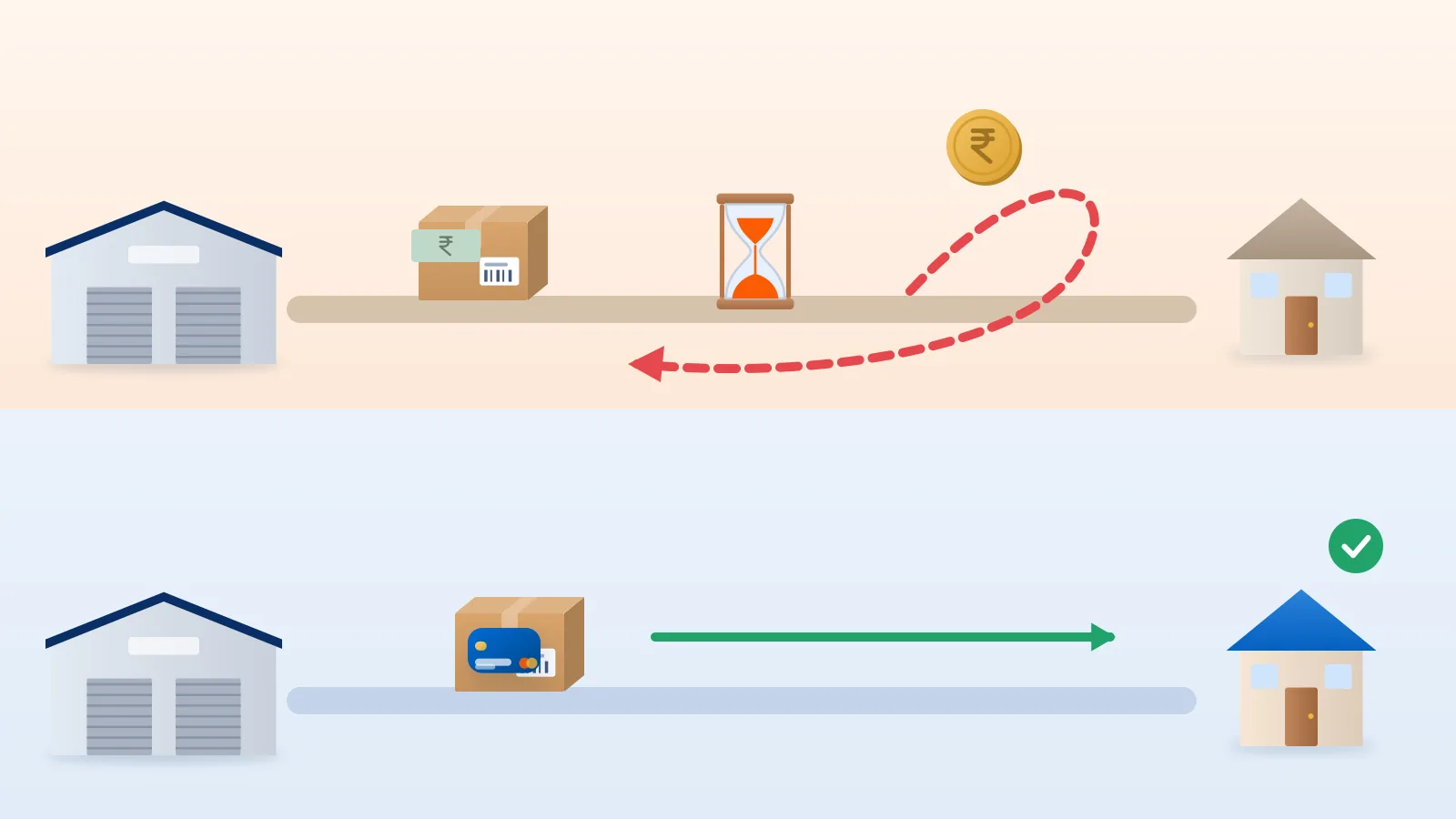
Cash on delivery (COD) and prepaid orders look the same once they are packed. The box, the label and the courier can all be identical. The difference shows up in your costs, your cash flow and how often parcels come back. This guide covers the shipping side of COD vs prepaid, so you can decide where COD earns its place in your store.
What changes between a COD and a prepaid order
With a prepaid order, the buyer pays online at checkout. The money reaches you through your payment gateway, and the courier only has to deliver the parcel.
With a COD order, the courier does two jobs: it delivers the parcel and collects the payment at the door. That second job changes four things.
- The courier handles cash for you. The delivery agent collects the order value from the buyer and the courier holds it until it is paid out.
- There is a COD charge on the shipment. Couriers commonly bill a separate fee for collecting and handling the cash, added to the freight.
- Your money arrives later. You are paid after delivery, on the courier’s or platform’s remittance cycle, not at the moment of sale.
- You have to reconcile. You need to check that every delivered COD order has been paid out, and for the right amount.
| Prepaid | COD | |
|---|---|---|
| When the buyer pays | At checkout | At the door |
| Who collects the money | Your payment gateway | The courier |
| Extra shipping fee | Usually none | COD charge per shipment |
| When you get paid | Per your gateway’s settlement | After delivery, on the remittance cycle |
| Reconciliation | Gateway settlements | Courier remittances against delivered AWBs |
| Return risk | Lower, as the buyer has already paid | Higher, as the buyer can refuse at the door |
COD charges: how couriers price them
Couriers price COD in one of a few common ways:
- a flat fee per COD parcel;
- a percentage of the order value being collected;
- whichever is higher of a flat fee and a percentage, which is the most common structure.
At the time of writing (October 2026), Amazon Shipping India’s small and medium delivery page says COD charges are ₹30 per parcel or 1.5% of the product value, whichever is higher, and that prepaid deliveries carry no extra charge. Delhivery’s help centre says COD shipments carry an additional cash-handling charge and points sellers to the rate card in the Delhivery One panel for the exact figure.
The “whichever is higher” rule means the fee grows with your basket size once you pass a break-even point.
Example (hypothetical numbers, for illustration only): say a courier charges ₹40 or 2% of the order value, whichever is higher.
| Order value | 2% of order value | COD charge applied |
|---|---|---|
| ₹1,000 | ₹20 | ₹40 (flat fee is higher) |
| ₹2,000 | ₹40 | ₹40 (both equal) |
| ₹5,000 | ₹100 | ₹100 (percentage is higher) |
GST is normally added to courier charges, including the COD charge. Read your own rate card carefully. It should say whether the COD charge is refunded or still billed when a COD parcel comes back as RTO. To see freight and COD charges side by side for a lane, try the shipping rate calculator. For how weight and zones affect the freight part, see volumetric weight and shipping charges.
COD remittance cycles and your cash flow
Once a COD parcel is delivered, the collected cash is paid out to you in batches on a fixed cycle. Cycles are usually counted from the delivery date, not the order date. Some providers offer a faster cycle, and a faster plan may cost extra.
Remittance can also depend on your account being in order. At the time of writing, Delhivery’s COD remittance page says the COD amount is transferred within 48 hours of delivery to the bank account saved in Delhivery One. It also says that if the seller’s Delhivery wallet balance is negative, the remittance is processed in the next cycle once the wallet is back in credit. Other couriers and shipping platforms set their own cycles and conditions, so check yours.
Why this matters: every day between delivery and remittance is a day your cash is held outside your business. You have already paid for the stock, the packaging and usually the freight. If a large share of your orders are COD, that gap can tie up a meaningful amount of working capital.
Example (hypothetical): if you deliver COD orders worth ₹10,000 every day and your cycle is seven days after delivery, about ₹70,000 of collected cash is waiting to reach you at any time. Move more buyers to prepaid, or pick a shorter cycle, and that figure falls.
RTO risk and NDR: why COD parcels come back more often
A prepaid buyer has already paid, so they have a reason to accept the parcel. A COD buyer has not. They can refuse it at the door, be unreachable, or not have the cash ready. Each failed attempt raises a non-delivery report (NDR). If the issue is not resolved within the courier’s attempts, the parcel goes back to you as a return to origin (RTO).
An RTO on a COD order hurts more than one on a prepaid order:
- you have paid forward freight and usually return freight, with no sale to show for it;
- the stock is out of saleable circulation while it travels back;
- you may still be billed the COD charge, depending on your rate card.
Prepaid orders can also fail, through wrong addresses or buyers who are away, but the buyer’s commitment is higher. For the full process of acting on NDRs and cutting RTO, read our guide to NDR and RTO in ecommerce.
Reconciling COD remittances: a simple monthly routine
Reconciliation means matching each remittance from your courier or platform with the delivered COD orders it covers. Do it at least monthly. Weekly is better if COD is a large share of your orders.
- Export your delivered COD orders for the period: order number, AWB, delivery date and COD amount.
- Download the remittance statements for the same period. Most providers list the AWBs included in each payout.
- Match by AWB. Each delivered COD AWB should appear in one remittance, for the amount collected.
- Check the deductions. If your provider deducts freight, COD charges or other fees from remittances, confirm they match your rate card.
- List the gaps. Flag AWBs that are delivered but not yet remitted after the cycle has passed, and amounts that differ from the order value.
- Raise tickets with AWB numbers for each gap and track them until they are closed.
- Match bank credits. Confirm that each remittance reached your bank account for the stated amount.
- Hand the records to your accountant. Keep the statements and your matched sheet for your books. Confirm GST treatment of COD charges with your CA.
A shared spreadsheet with one row per AWB is enough for most small sellers.
Nudging buyers towards prepaid
You cannot force every buyer to pay online, but you can make prepaid the easier choice. Common prepaid order incentives include:
- A prepaid discount, such as a small amount off or free shipping on prepaid orders.
- A COD fee at checkout that passes on some or all of your COD charge. Show it clearly and early, on the product page or before the payment step, and in the order total before the buyer confirms. Never add it after the order is placed or hide it in the final step.
- COD order confirmation by message or call before dispatch, to filter out orders the buyer did not mean to place. Many sellers ship a COD order only after the buyer confirms.
- Clear delivery and returns information, which removes some of the doubt that makes buyers choose COD.
- Trust signals at checkout, such as a visible returns policy and contact details.
Showing every charge upfront is good practice in any case. Consumer-protection rules in India also cover how prices and fees are disclosed online. Confirm the current requirements with your legal adviser before adding a COD fee.
Some couriers let the delivery agent accept digital payment at the doorstep instead of cash. Availability varies, so check with your courier before telling buyers about it.
When to offer COD, limit it or go prepaid-only
There is no single right answer for COD vs prepaid. Use your own delivery and RTO data to decide.
| Situation | Suggested approach | Why |
|---|---|---|
| New store, first-time buyers, low to mid order values | Offer COD, with order confirmation | COD can win buyers who will not yet trust you with an online payment |
| High-value orders | Limit COD, for example with a cap on order value or a partial advance | More cash and stock is at risk if the parcel is refused |
| Pincodes with repeated refusals or RTOs in your data | Turn COD off for those pincodes | Keeps COD where it converts and cuts it where it returns |
| Repeat buyers who have refused COD parcels before | Offer prepaid only for that buyer | Protects you from repeat refusals |
| Custom, made-to-order or perishable products | Go prepaid-only | A returned parcel may not be resaleable |
| Tight cash flow | Push prepaid with incentives; review your remittance cycle | Shortens the gap between sale and cash |
| COD orders mostly delivered and reconciled without issues | Keep offering COD | The extra sales may outweigh the COD charge and remittance delay |
Before you limit COD by pincode, check which couriers can deliver and collect cash there. The pincode serviceability checker helps. If you run a Shopify or WooCommerce store, our Shopify shipping guide and WooCommerce shipping guide cover order and checkout setup. For other ways to cut costs, see how to reduce shipping costs.
COD and prepaid on Courier Tales
Courier Tales supports both COD and prepaid orders. For COD orders, a COD charge is added to the estimated shipping charge, and GST at 18% is added to charges. You choose your COD remittance plan. The default is D+7, seven days after delivery, and faster plans may carry a fee. Failed delivery attempts appear in the NDR list for action, and RTO shipments stay visible until they reach your pickup address.
Want to compare COD and prepaid charges for your own orders? Create a Courier Tales account and check the estimates before you book.
Frequently asked questions
Is a COD order more expensive to ship than a prepaid order?
Usually yes. Couriers commonly add a COD charge for collecting and handling the cash, on top of the freight. At the time of writing, Amazon Shipping India charges ₹30 per parcel or 1.5% of the product value, whichever is higher, while prepaid deliveries carry no extra charge.
When do I receive the money from a COD order?
After the parcel is delivered, the courier or shipping platform remits the collected cash to you on a set cycle. The cycle depends on your provider and plan, so check the remittance terms in your agreement.
Can I charge buyers an extra fee for choosing COD?
Many sellers do, but the fee must be shown clearly before the buyer places the order, not added later. Confirm the current consumer-protection rules with your adviser.
Should I stop offering COD altogether?
Not necessarily. COD can bring in buyers who will not pay upfront. Many sellers keep it but limit it, for example on high-value orders or on pincodes where returns have been high.
Sources
- Small and medium delivery, Amazon Shipping India (accessed 19 October 2026)
- Rate Card, Delhivery One Help Center (accessed 19 October 2026)
- COD Remittance, Delhivery One Help Center (accessed 19 October 2026)
Courier, marketplace and tax rules change. Check the current terms with your courier, marketplace or adviser before relying on them.