
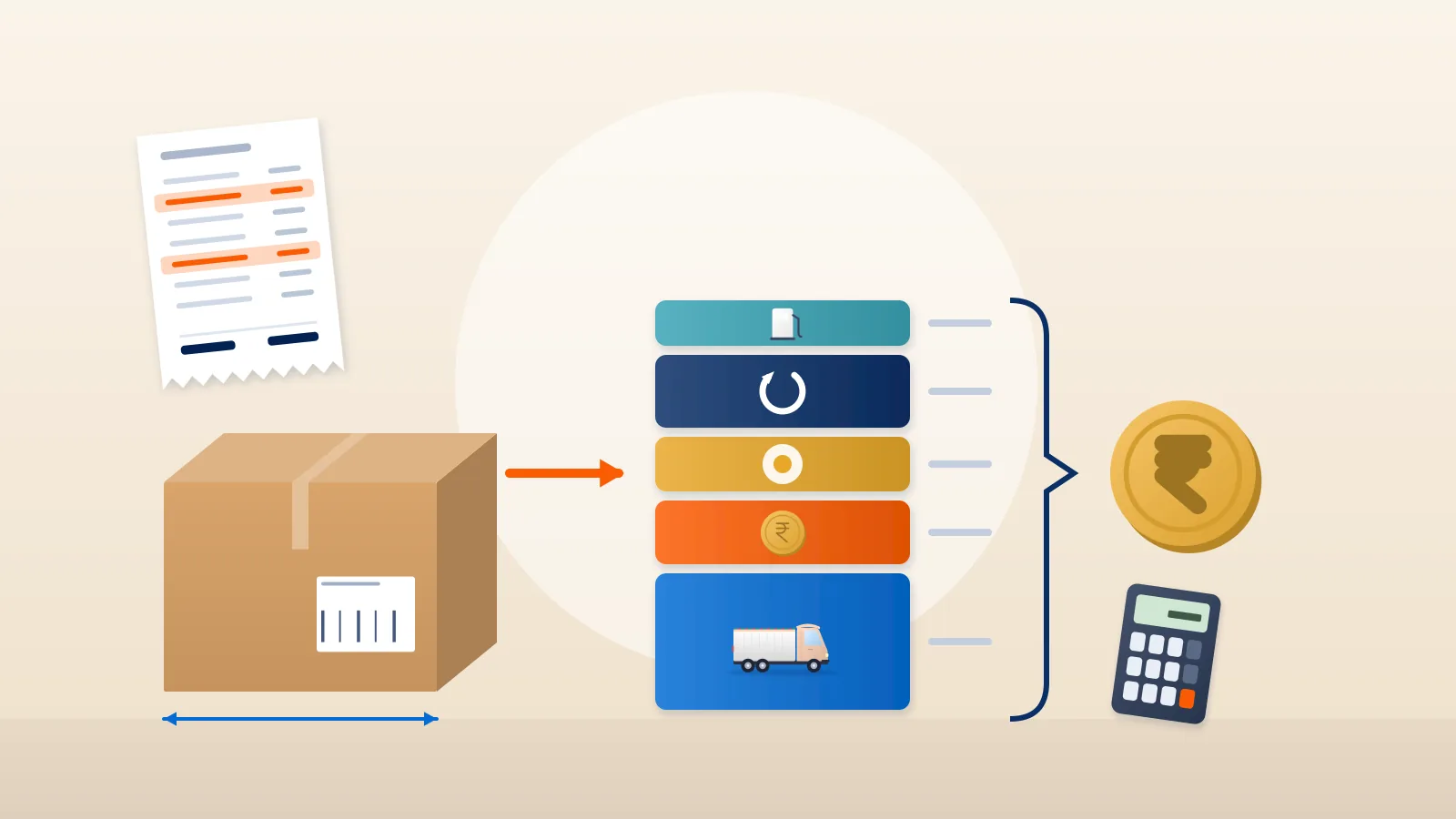
Ask a small seller what shipping costs per order and the answer is usually the number on the courier rate card: “About ₹60 for a half-kilo parcel.” That figure is real, but it is only one line of the cost. The box, the tape, the time spent packing, the COD charge, the parcels that come back and the occasional weight adjustment all belong to shipping too. Leave them out and your margins look healthier than they are.
This guide shows you how to calculate your true shipping cost per order, split it so you can see where the money goes, and then decide what to fix first. If you already know your numbers and want a list of ways to lower them, our guide on how to reduce shipping costs covers the levers in detail.
Three numbers, three different answers
Sellers use “shipping cost” loosely. Be clear which of these you mean:
| Measure | Formula | What it tells you |
|---|---|---|
| Rate per shipment | Courier freight for one parcel | What the courier charges; useful for comparing couriers |
| Cost per shipment | All shipping costs ÷ shipments sent | Your average spend per parcel, including failures |
| Cost per delivered order | All shipping costs ÷ orders delivered | What each successful sale cost to ship |
The third is the one to manage your business by. It is always higher than the first, and the gap between them is where most hidden cost sits.
What goes into the true cost
List every cost that exists only because you ship. Typical lines:
- Packaging. Boxes or mailers, filler, tape, the label and any insert or thank-you card.
- Packing time. Wages for the time spent picking, packing, weighing and labelling. If you pack yourself, put a value on your hour anyway.
- Forward freight. What the courier charges to deliver, based on chargeable weight and zone, plus surcharges such as fuel or a destination city charge where they apply.
- COD charges. The extra charge couriers commonly add for cash handling on COD parcels.
- RTO costs. Return freight on parcels that come back, plus packaging you cannot reuse.
- Damage and write-offs. Products damaged in transit or returned unsellable, net of any claim you recover.
- Weight adjustments. Extra charges when the courier’s measured weight is higher than what you declared.
- GST on courier charges. Count it if you cannot claim input tax credit. Your CA can confirm your position.
Then subtract what buyers pay you for shipping, if you charge a shipping or COD fee. That gives you net shipping cost.
Do not guess the freight line
Freight depends on chargeable weight, which is the higher of actual and volumetric weight. At the time of writing, Delhivery’s help centre gives volumetric weight as length × breadth × height in cm divided by 5000 for surface and express, and says parcels in flyers are charged on dead weight up to 1 kg. Other couriers may use different rules. A box only slightly too big can push every order of a product into a higher slab, so measure packed parcels, not products. Our guide to volumetric weight and shipping charges explains the slab maths.
Freight also changes with the zone. Delhivery’s rate card, for example, sets zones by pickup and delivery pincodes, from local to special regions, and adds a destination city surcharge in select cities on top of zone rates. Your average freight is a mix of all your lanes, so calculate it from your actual invoices, not from one quote.
A worked example
All figures below are illustrations, not quoted courier rates or Courier Tales rates.
Kavya sells scented soy candles from Coimbatore through her own website. Her average order value is ₹899. Last month she sent 400 parcels: 200 prepaid and 200 COD. Four prepaid parcels and 20 COD parcels came back as RTO, so 376 orders were delivered.
Her inputs:
- Packaging (box, filler, tape, label, card): ₹26 per parcel
- Packing time: a part-time helper costs ₹3,600 a month, or ₹9 per parcel
- Average forward freight across all lanes: ₹65 per parcel
- COD charge: ₹35 per COD parcel, assumed billed on every COD parcel including returns
- Return freight on RTO: ₹65 per parcel
- Weight adjustments for the month: ₹600
- Damaged candles written off: ₹1,200
- GST is left out because she is registered and her CA confirmed she can claim the credit
The month in one table
| Cost line | Prepaid (200 sent, 196 delivered) | COD (200 sent, 180 delivered) | Total |
|---|---|---|---|
| Packaging | ₹5,200 | ₹5,200 | ₹10,400 |
| Packing time | ₹1,800 | ₹1,800 | ₹3,600 |
| Forward freight | ₹13,000 | ₹13,000 | ₹26,000 |
| COD charges | ₹0 | ₹7,000 | ₹7,000 |
| RTO return freight | ₹260 | ₹1,300 | ₹1,560 |
| Weight adjustments | ₹600 | ||
| Damage write-offs | ₹1,200 | ||
| Total | ₹20,260 | ₹28,300 | ₹50,360 |
| Per delivered order | ₹103.37 | ₹157.22 | ₹133.94 |
(Weight adjustments and write-offs are not split by payment mode here, so the segment columns leave them out.)
Kavya had been telling herself shipping cost “about ₹65”. The true figure is ₹133.94 per delivered order, roughly 14.9% of her ₹899 average order value. A delivered COD order costs her about ₹54 more than a prepaid one.
If she charges a ₹49 shipping fee on smaller orders and collected ₹5,880 from buyers on delivered orders last month, her net shipping cost is (₹50,360 − ₹5,880) ÷ 376 = ₹118.30 per delivered order.
Build your own sheet
You do not need software for this. A spreadsheet with one row per month and these columns is enough:
- Shipments sent, prepaid and COD
- RTOs, prepaid and COD
- Delivered orders
- Packaging spend, packing labour
- Forward freight, COD charges, RTO freight, surcharges, weight adjustments (from courier invoices)
- Damage write-offs and claim recoveries
- GST, if not claimable
- Shipping fees collected from buyers
- Average order value
Add three formula columns: cost per delivered order, net cost per delivered order, and shipping cost as a percentage of average order value. Once a month has passed, split it further by zone and by your top five products. A heavy product shipped mostly to far zones can quietly lose money while the overall average looks fine.
Know your cost before you book. Courier Tales shows estimated charges from each integrated courier that serves the route, with chargeable weight worked out as the higher of actual and volumetric weight; GST at 18% is added to the charges.
Now cut it: start with your largest line
Do not try to fix everything at once. Rank your cost lines by size and work from the top. In Kavya’s example, forward freight is the largest line, but the COD and RTO lines are the ones that make COD orders cost far more.
| If your biggest problem is… | Where to look |
|---|---|
| Forward freight | Box sizes, slab edges and courier choice per route; see how to reduce shipping costs and compare lanes on the shipping rate calculator |
| COD charges | Your payment mix; see how to convert COD to prepaid |
| RTO freight and write-offs | Address checks, COD confirmation and fast NDR action; see how to reduce RTO |
| Weight adjustments and surprise lines | Declared weights, evidence and surcharges; see unexpected courier charges |
| Packaging and packing time | A smaller set of standard boxes, a fixed packing station and pre-cut filler |
After each change, wait a full month and recalculate. If cost per delivered order did not move, the change did not work, however sensible it sounded.
Use the number in pricing decisions
Once you trust your figure, put it to work:
- Product pricing. Check each product’s margin after its own shipping cost, not the average. Light, high-value items carry shipping easily; heavy, low-price items often do not.
- Shipping fees and thresholds. If you absorb shipping above a basket value, set that value from your real cost per delivered order, not the rate card.
- COD policy. When a COD order costs noticeably more than a prepaid one, a small COD fee or a prepaid incentive has a clear basis.
- Bundles. Selling two or three units in one parcel spreads one shipping cost over a bigger order.
Final thoughts
Shipping cost per order is not one number on a rate card. It is the sum of everything you spend to get a product to a buyer, divided by the buyers who actually received it. Calculate it honestly once a month, split it by payment mode, zone and product, and fix the biggest line first.
Create your Courier Tales account to see estimated charges from several couriers before you book, and track every shipment from one dashboard.
Frequently asked questions
What is a good shipping cost per order?
There is no single right figure. It depends on your product's weight, where your buyers live, your COD share and your prices. A more useful test is shipping cost as a share of average order value, tracked month by month, alongside your gross margin.
Should packaging be counted in shipping cost per order?
Yes. Boxes, mailers, filler, tape and labels are spent on every order and would not exist without shipping. Leaving them out makes shipping look cheaper than it is, especially for low-value orders.
Why divide by delivered orders instead of shipments?
Returned parcels still cost you freight, packaging and often a COD charge, but bring in no revenue. Spreading total cost over delivered orders shows what each successful sale really cost to ship.
Should I include GST in shipping cost per order?
If you are GST-registered and can claim input tax credit on courier invoices, you may leave GST out of your cost. If you cannot claim it, include it. Confirm your position with your chartered accountant.
How often should I recalculate shipping cost per order?
Once a month is enough for most sellers, and after any big change such as a new box size, a new courier, a rate revision or a shift in your COD share.
Sources
- Calculating Volumetric Weight, Delhivery One Help Center (accessed 2 November 2026)
- Rate Card, Delhivery One Help Center (accessed 2 November 2026)
Courier, marketplace and tax rules change. Check the current terms with your courier, marketplace or adviser before relying on them.