
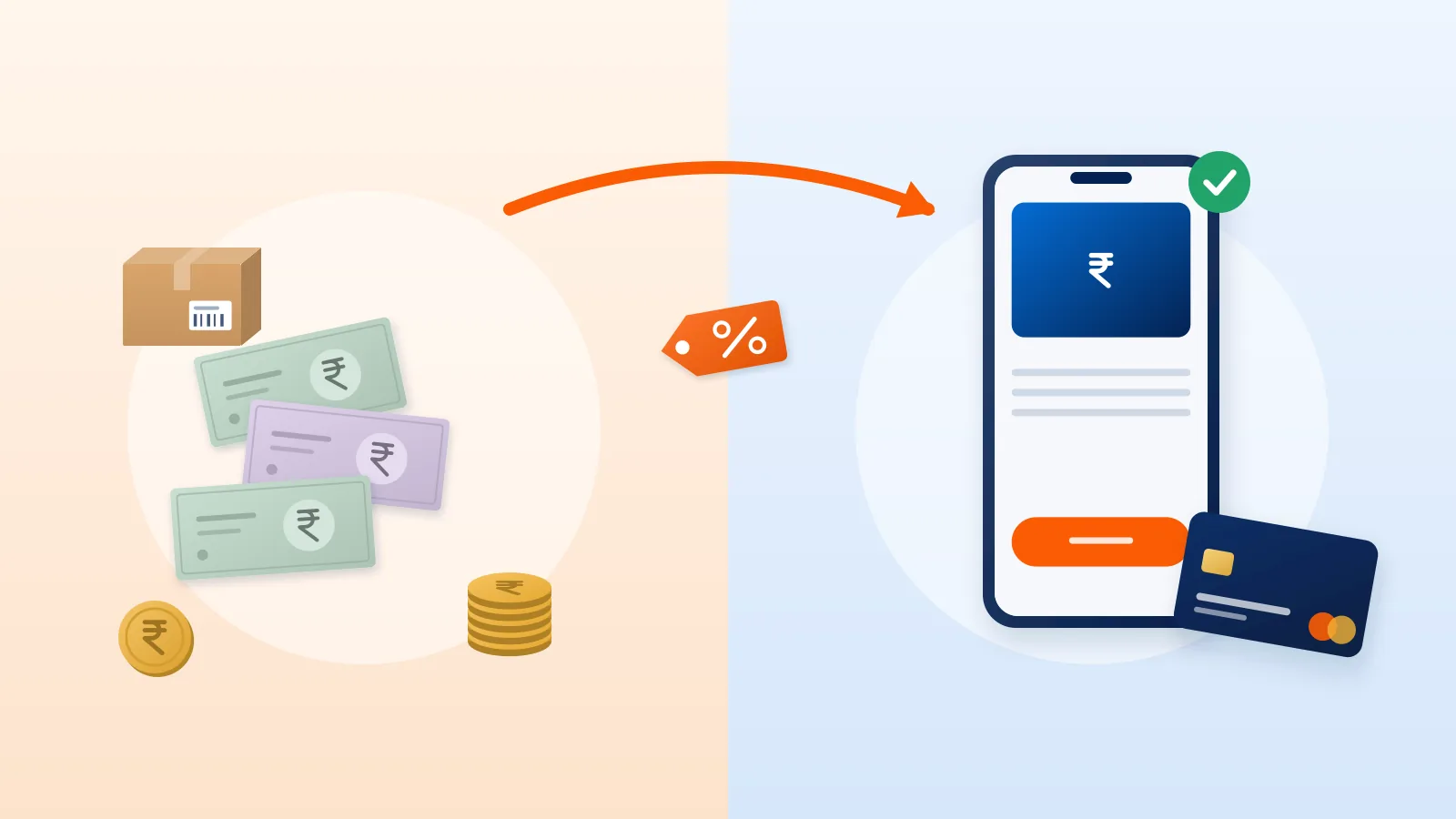
Ask ten Indian sellers whether COD or prepaid is better and most will say prepaid, then admit that a large share of their orders still come in as cash on delivery. Buyers like COD because it removes risk for them. Sellers tolerate it because it brings sales they would otherwise lose.
The useful question is not which payment mode is better in general. It is what a COD order costs your business, where that cost is worth paying, and how to convert COD to prepaid wherever it is not. This guide covers that decision and the tactics. For the shipping mechanics of COD, such as how couriers price COD charges and how remittance works, read our guide to COD vs prepaid shipping considerations first.
What a COD order really costs
A COD order carries three costs a prepaid order does not.
- The COD charge. Couriers commonly bill a fee for collecting cash. At the time of writing, Amazon Shipping India lists ₹30 per parcel or 1.5% of the product value, whichever is higher, and no extra charge for prepaid. Other couriers price it differently.
- Refusals and RTO. A COD buyer has paid nothing, so saying no at the door costs them nothing. Each refusal costs you forward freight, usually return freight, packaging and days of blocked stock.
- Waiting for your money. COD cash reaches you after delivery, on a remittance cycle. That gap has a cost, which our guide on COD settlement and cash flow works through.
An expected-cost comparison
Put the three together and compare 100 COD orders with 100 prepaid orders. All numbers below are an illustration for a ₹799 product, not quoted rates.
| Per 100 orders | Prepaid | COD |
|---|---|---|
| COD charges (₹35 each, delivered orders only in this example) | ₹0 | ₹2,940 (84 × ₹35) |
| Orders refused or returned (assumed rate) | 5 | 16 |
| Loss per returned order (forward + return freight + packaging) | ₹140 | ₹140 |
| Total return loss | ₹700 | ₹2,240 |
| Extra cost of the COD batch | ₹4,480 more |
In this example, the 100 COD orders cost about ₹45 more per order than prepaid ones before you even count the wait for cash. Plug in your own refusal rates by payment mode, your rate card and your average loss per RTO. Your numbers will differ, sometimes a lot.
That ₹45 is the figure to keep in mind. It tells you how much you can afford to spend to move one buyer from COD to prepaid.
When COD is still the right call
COD earns its place when it brings in buyers who would not otherwise order at all. That is common when:
- the buyer is new to your store and has never heard of your brand;
- your traffic comes from Instagram, Facebook ads or WhatsApp, where buyers have not seen your returns policy;
- you sell to smaller towns where paying online to an unknown seller still feels risky;
- your order value is low and the refusal loss per parcel is small.
COD is harder to justify for made-to-order, personalised or perishable products, for high order values, and for buyers who have refused a COD parcel from you before.
How to convert COD to prepaid: eight tactics
None of these works alone. Most sellers who raise their prepaid share combine three or four of them.
1. Make prepaid the default at checkout
Put UPI first and pre-selected, with COD listed lower. Show the UPI app icons buyers recognise. A buyer who sees a familiar payment method one tap away often uses it. Our guide to improving ecommerce conversion rate covers the wider checkout set-up.
2. Size the prepaid incentive with your own maths
A prepaid discount or waived shipping fee works, but only if it costs less than the COD order you are avoiding. In the example above, any incentive under about ₹45 per order pays for itself if it moves a buyer. A flat amount is easier for buyers to understand than a percentage. Say it plainly on the product page, in the cart and at payment: “Pay online and save ₹30”.
3. Show a COD fee upfront, not at the end
Some sellers pass part of the COD cost to the buyer as a COD fee. If you do, show it before the buyer confirms the order. Revealing charges only at the last step looks like a trick, and India’s Central Consumer Protection Authority lists “drip pricing” among the dark patterns in its 2023 guidelines. Confirm your checkout wording with your adviser.
4. Ask for payment after the order, before dispatch
Many COD buyers will pay online once they trust you. After a COD order comes in, send a WhatsApp or SMS message that confirms the order and offers a payment link: “Pay now by UPI and we dispatch today.” Keep the COD option open for those who decline. This one step also works as your COD confirmation, which cuts refusals (see our RTO reduction playbook).
5. Take a partial advance on high-value orders
For orders above a value you set, ask for a small advance online and the balance at the door. The buyer has committed money, so refusals drop. Check that your store platform and payment gateway support split payments.
6. Limit COD by value, pincode and buyer
Use your data. Switch COD off above a value cap, for pincodes where COD refusals keep repeating, and for buyers who have refused before. Before you change pincode rules, check which couriers serve each area for COD on the pincode serviceability checker.
7. Remove the doubts that make buyers choose COD
Buyers often pick COD because they worry about fraud, slow delivery or difficult returns. Show your contact number, business address, returns policy and a realistic delivery estimate near the payment button. Share the tracking link as soon as the order ships.
8. Reward repeat buyers who pay online
Your second and third orders come from people who already trust you. Offer them a prepaid-only perk, such as early access to a sale. Our guide to repeat customers covers retention in more depth.
Running both COD and prepaid? Ship both payment modes from one dashboard and follow COD collections against each order, so you can see what COD is really costing you.
Measuring whether it works
Change one thing at a time and give it two to four weeks. Track:
| Metric | How to calculate | Why it matters |
|---|---|---|
| Prepaid share | Prepaid orders ÷ all orders | Shows whether tactics are moving buyers |
| Checkout conversion | Orders ÷ checkout starts | Catches tactics that push buyers away |
| RTO rate by payment mode | RTOs ÷ shipments, split COD and prepaid | Shows the real gap between the two |
| Cost per COD order | COD charges + return losses ÷ COD orders | Tells you how much an incentive can cost |
| Post-order conversion | COD orders paid via link ÷ links sent | Measures tactic 4 on its own |
If your prepaid share rises but total orders fall by more than the savings, ease off. The goal is profit per order, not a prepaid percentage.
A quick decision checklist
- I know my refusal rate for COD and for prepaid, separately.
- I know my average loss per RTO.
- My prepaid incentive is smaller than the extra cost of a COD order.
- Any COD fee is shown before the buyer confirms.
- COD has a value cap and a pincode block list built from my own data.
- COD buyers get a confirmation message with a payment link before dispatch.
- I review these numbers monthly.
COD and prepaid on Courier Tales
Courier Tales lets you ship COD and prepaid orders and choose a COD remittance plan. The default plan remits seven days after delivery (D+7), and faster plans may carry a fee. You can follow COD collections against each order and use COD money to recharge your shipping wallet. For each shipment you see the couriers that serve the route, with estimated charges, before you book.
Whichever way your buyers pay, the aim is the same: fewer parcels coming back and money in your account sooner. Create your Courier Tales account to ship both payment modes and keep track of every COD rupee.
Frequently asked questions
Is COD or prepaid better for a small online business?
Neither is better in every case. Prepaid gives you money upfront and fewer refusals, while COD can win first-time buyers who do not yet trust your store. Compare the expected cost of a COD order, including refusals, with the extra sales COD brings, and decide by product, order value and pincode.
How much prepaid discount should I offer?
Size it against what a COD order costs you on average, not against a competitor's offer. If the discount is smaller than the COD charge plus your expected loss from COD refusals, it usually pays for itself. Test one amount for a few weeks before changing it.
Can I charge a fee for cash on delivery?
Many sellers do. Show the fee clearly before the buyer confirms the order, on the product page or at the payment step, and never add it afterwards. India's consumer-protection rules cover how charges are disclosed online, so confirm the current position with your adviser.
What is partial COD?
Partial COD means the buyer pays a small advance online and the rest in cash at delivery. The advance shows commitment, which tends to cut refusals on high-value orders. Your store platform or payment gateway needs to support it.
Will removing COD reduce my sales?
It can, especially with first-time buyers outside the big cities. That is why many sellers limit COD rather than remove it: they cap it by order value, switch it off for pincodes with repeated refusals, or keep it only for new buyers.
Sources
- Small and medium delivery, Amazon Shipping India (accessed 2 November 2026)
- CCPA notifies Guidelines for Prevention and Regulation of Dark Patterns, 2023, SCC Online (accessed 2 November 2026)
Courier, marketplace and tax rules change. Check the current terms with your courier, marketplace or adviser before relying on them.