
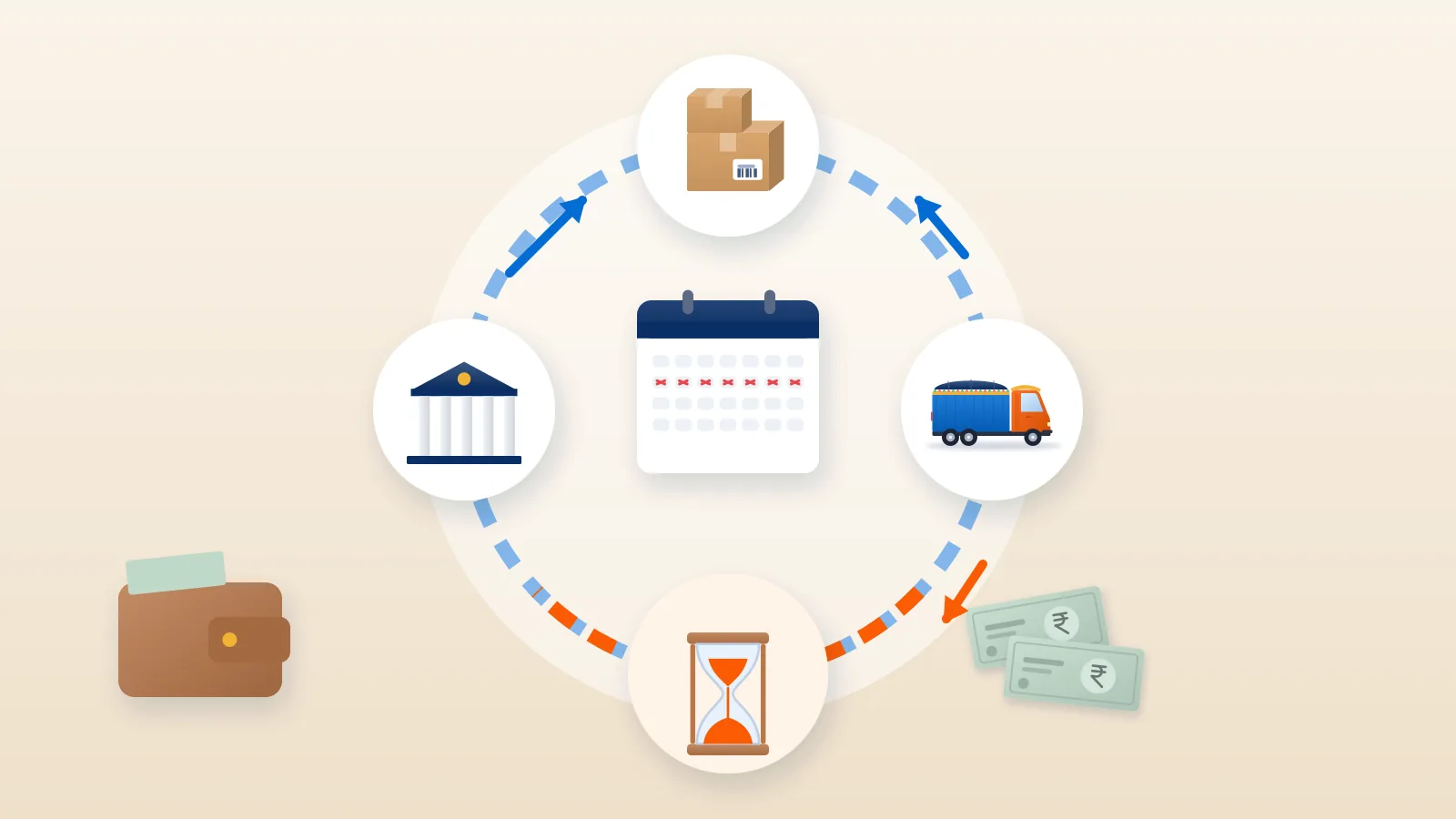
A seller with a profitable product and steady orders can still run short of cash. The reason is often cash on delivery. Every COD order is a sale you have already paid for (stock, packaging, freight) but whose money is still out on the road or waiting in a remittance cycle.
This guide shows how COD settlement affects cash flow, with a worked cash-cycle example, a simple formula for how much money is locked up, and the levers that release it. For the shipping basics of COD (charges, remittance cycles and reconciliation), see our guide to COD vs prepaid shipping.
Where the money goes in a COD order
Follow one COD order from the day you buy stock to the day its cash reaches your bank.
- You pay for stock. Usually days or weeks before the sale.
- The order arrives and you dispatch it. Freight and the COD charge are paid or deducted now.
- The parcel travels. How long depends on the distance, the service and the courier.
- The courier delivers and collects cash. The money is collected but not yours yet.
- Remittance. On your cycle, counted from the delivery date, the cash is paid out.
- Bank credit. Only now can you use it to pay a supplier.
With a prepaid order, the money starts moving at checkout through your payment gateway’s settlement cycle, before the parcel has even left. With COD, steps 3 to 5 sit between your spending and your income.
A worked cash-cycle example
All figures are an illustration, not quoted rates or timelines.
Farhan sells leather wallets and belts from Kanpur through his own website and Instagram. His average order is ₹1,000. On a normal day he delivers 40 COD orders. Parcels take about four days to reach buyers, and his COD remittance is D+7: seven days after delivery.
Timeline for one COD order
| Day | Event | Cash position for this order |
|---|---|---|
| Day −21 | Pays supplier for the wallet (₹380) | −₹380 |
| Day 0 | Order dispatched; freight and COD charge deducted (₹95) | −₹475 |
| Day 4 | Delivered; buyer pays ₹1,000 in cash to the courier | −₹475 (cash is with the courier) |
| Day 11 | COD remitted (D+7) | +₹525 |
From paying his supplier to getting the money back takes Farhan 32 days for this order. The profit is real, but it arrives a month after he spent the money.
Cash locked in the COD pipeline
Now look across all orders rather than one. On any given day, Farhan has:
- In transit: about 4 days × ₹40,000 = ₹1,60,000 of COD orders on the road;
- Delivered, awaiting remittance: about 7 days × ₹40,000 = ₹2,80,000 collected but not yet paid out.
That is roughly ₹4,40,000 of sales that he has funded but cannot spend. It is not lost, but it is not in his bank either.
The general formula:
Cash locked in COD ≈ COD value delivered per day × (days in transit + remittance days)
Every day you take off either part releases about one day of COD value. In Farhan’s case, one day is ₹40,000.
What happens in a festive peak
Before Diwali, Farhan’s orders double for three weeks. His locked cash doubles too, to about ₹8,80,000, at exactly the time he needs to pay suppliers for more stock. This is how a seller with record sales ends up borrowing in October. Plan your festive buying with this in mind; our festive season guide covers the wider calendar.
Other things that slow COD money down
- Returns in transit. RTO parcels carry stock that cannot be sold until it is back and checked.
- Wrong bank details. Remittances can bounce or be held. Delhivery’s help centre, for example, asks sellers to keep bank details correct to receive remittances on time.
- Negative wallet balances. Some providers hold COD payouts if your shipping wallet is negative. At the time of writing, Delhivery’s COD remittance page says that in this case the remittance is processed in the next cycle once the wallet is positive.
- Unreconciled gaps. A delivered order that never appears in a remittance is cash you will not get unless someone notices. Our guide to COD reconciliation shows how to catch these.
Want your COD money to keep shipping moving? Courier Tales lets you choose a COD remittance plan (the default is D+7) and use COD money to recharge your shipping wallet.
Seven ways to release cash from COD
1. Shift buyers to prepaid
Every order that moves from COD to prepaid leaves the pipeline completely. Even a modest shift changes the formula above. Our guide on how to convert COD to prepaid covers the tactics.
2. Dispatch faster
Transit days count. An order packed on the day it arrives starts its journey a day earlier than one packed the next morning. For urgent or high-value lanes, compare surface and air services; see surface vs air shipping.
3. Choose your remittance plan with maths, not mood
Faster remittance plans may carry a fee. Weigh that fee against what earlier money is worth to your business: whether it lets you restock a fast-selling product sooner, pay a supplier on time or avoid borrowing. Many sellers find a faster plan most useful at particular times, such as before a festive stock-up. Run the numbers with your actual fee, your order volume and your cost of borrowing.
4. Use COD money for shipping costs
If your shipping platform lets you recharge the shipping wallet from COD money, you avoid moving cash from your bank to the wallet and back. Courier Tales offers this. The money still has to arrive first, but you save a transfer and keep the bank balance for suppliers.
5. Keep the wallet in credit
Recharge before you run low, so freight deductions never push the balance negative. Where a provider holds payouts against a negative wallet, a small shortfall can delay a much larger remittance.
6. Reconcile every week
Match delivered COD orders against remittances weekly. Overdue items found in week one are easy to chase; items found three months later are not.
7. Line up supplier payments with your remittance calendar
If remittances land on predictable days, schedule supplier payments and stock orders after them. Some suppliers will offer credit terms once you have a track record; even a short credit period offsets part of the COD delay.
A one-page cash flow check
Fill this in every month:
| Line | Your figure |
|---|---|
| COD value delivered per day (average) | |
| Average days in transit | |
| Remittance days (from your plan) | |
| Cash locked in COD (formula above) | |
| Value of RTO stock in transit | |
| Overdue remittances found in reconciliation | |
| Prepaid share of orders |
Watch the trend. If cash locked in COD grows faster than your sales, your payment mix or your remittance plan needs attention.
COD settlement on Courier Tales
With Courier Tales you ship COD and prepaid orders, choose a COD remittance plan, and follow COD collections against each order. The default plan remits seven days after delivery (D+7), and faster plans may carry a fee. Shipping charges are deducted per shipment from a wallet you recharge, and you can use COD money for that recharge.
Profit you cannot spend does not pay suppliers. Create your Courier Tales account and see exactly where your COD money is, order by order.
Frequently asked questions
What does D+7 COD remittance mean?
D+7 means the cash collected on a COD order is remitted seven days after the delivery date. The count starts from delivery, not from the order or dispatch date, so the time a parcel spends in transit comes on top.
How do I calculate how much cash is stuck in COD?
Multiply the value of COD orders you deliver on an average day by the number of days between dispatch and remittance. That gives a rough figure for cash that is collected or about to be collected but not yet in your bank.
Is it worth paying a fee for faster COD remittance?
Compare the fee with what the money is worth to you. Convert the fee into an annual rate for the days you gain and compare it with what you pay to borrow. It can be worth it during a stock-up period or festive peak, and poor value the rest of the year.
Why is my COD remittance delayed?
Common reasons include parcels marked delivered late in a cycle, incorrect bank details, holds while a delivery is disputed and, with some providers, a negative wallet balance. Reconcile delivered COD orders against remittances and raise a ticket with the AWB numbers for anything overdue.
Does COD affect how much stock I can buy?
Yes. Money waiting in the COD pipeline cannot pay suppliers. Sellers with a high COD share often find they need more working capital to grow at the same pace as a mostly prepaid business.
Sources
- COD Remittance, Delhivery One Help Center (accessed 2 November 2026)
Courier, marketplace and tax rules change. Check the current terms with your courier, marketplace or adviser before relying on them.