
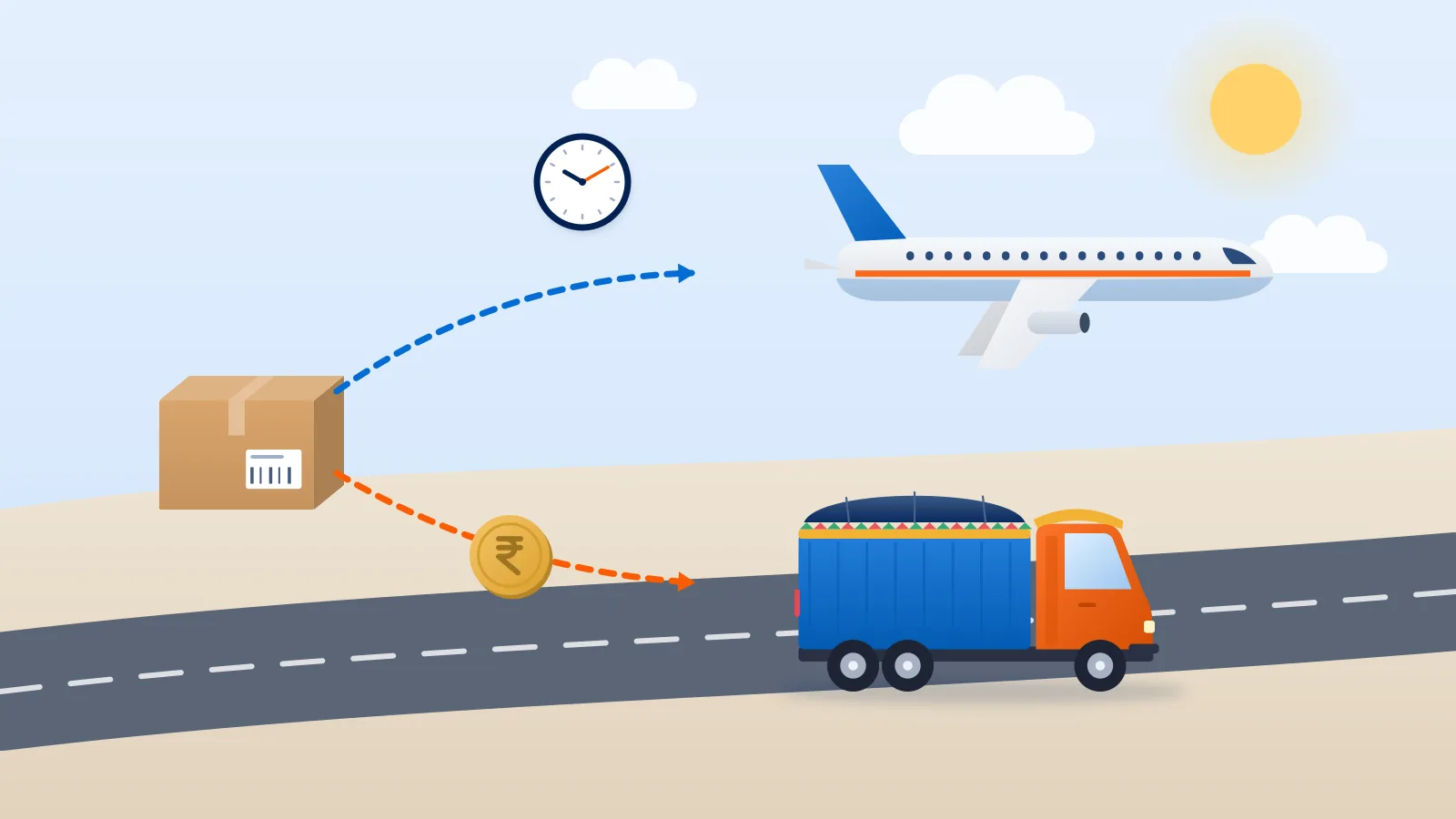
Every time you book a parcel you make a choice between road and air, even if the courier calls it “standard” and “express”. For most Indian online sellers, surface shipping carries the bulk of orders, and air is used selectively. Getting that split right affects your margin on every order and the delivery time your buyers see.
This guide explains how the two modes actually work for e-commerce parcels, where the difference in speed is real and where it is not, which products cannot go by air, and how to set simple rules so the decision is not made order by order.
What surface and air mean for a parcel
Surface means the parcel moves by road. It is picked up, taken to a hub, sorted, loaded onto a line-haul truck with thousands of other parcels, and moved hub to hub until it reaches the delivery centre near your buyer.
Air (often sold as “express”) means that, for the long-distance leg, the parcel is put on a flight. Pickup and last-mile delivery still happen by road. Delhivery’s rate card, for example, describes Surface as “movement of goods via Road” and Express as “movement of goods via Air (wherever feasible)” (Delhivery rate card). Note the words “wherever feasible”. Not every route has a flight that helps, so an express booking on a short route may still travel by road.
How they compare
| Factor | Surface | Air |
|---|---|---|
| Cost per kg | Lower | Higher |
| Speed on long routes | Slower, often by several days on far lanes | Quicker on the line-haul leg |
| Speed on short routes | Often similar to air | Often similar to surface |
| Weight sensitivity | Heavier parcels stay affordable | Costs rise quickly with weight |
| Restricted items | Fewer restrictions | Dangerous goods rules apply |
| Pickup and last mile | By road | By road |
| Good fit | Everyday orders, heavy or low-value items, COD orders | Urgent, high-value or long-distance prepaid orders |
The table above is general. Exact rates, transit times and restrictions depend on the courier, the lane and your rate plan, so check them against real quotes before you set rules.
Speed: where the gap is real
The time saved by air comes almost entirely from the long middle leg of the journey. Pickup, sorting at the first hub, and the last-mile delivery take roughly the same time either way.
That means:
- Within a city or state, air rarely saves much. A parcel from Pune to Nashik spends most of its time in pickup, sorting and delivery, not on the road between them.
- Between distant regions, air can save days. A parcel from Jaipur to Kochi, or from Ludhiana to Guwahati, spends a long time in line-haul trucks on surface.
- Remote and hilly pincodes may still need extra days after the flight lands, because the last leg is by road through difficult terrain.
Cost: weight decides most of it
Both modes charge on chargeable weight, the higher of actual and volumetric weight. With air, every extra half-kilogram costs noticeably more, so a bulky or heavy parcel can cost several times as much to fly as to send by road. Couriers can also use different volumetric divisors for different services, so read each rate card. Our guide on volumetric weight and shipping charges explains the calculation.
A light, compact product such as a pair of earrings or a phone case barely changes in cost between modes. A 3 kg pressure cooker or a cushion in a large carton does.
Restricted items: some products cannot fly
Air cargo follows dangerous goods rules. IATA notes that lithium batteries can be carried by air only depending on their configuration and watt-hour rating or lithium content, under its Dangerous Goods Regulations (IATA lithium batteries). On top of that, couriers publish their own restricted lists for air services, which commonly cover items such as aerosols, flammable liquids and some perfumes.
If you sell power banks, Bluetooth speakers, smartwatches, nail polish or attars, check each courier’s restricted-items list before booking by air. A parcel refused at the airport hub comes back to you, delayed and charged.
When surface is the right choice
Surface suits most everyday e-commerce orders:
- COD orders. A COD parcel already carries a higher chance of refusal. Paying air rates on a parcel that may come back as RTO makes the loss larger.
- Heavy or bulky products. Home goods, kitchenware, books in bulk and furniture parts.
- Low-value orders. On a ₹299 order, the extra cost of air can wipe out the margin.
- Short and medium routes. Within your state or neighbouring states, where air saves little.
- Products with restricted contents. Batteries, aerosols, liquids that couriers will not fly.
When air is worth paying for
- Long routes with a prepaid buyer who expects quick delivery.
- High-value products, where the extra charge is a small share of the order and fewer days in transit means fewer chances for damage or loss.
- Time-bound orders, such as Rakhi gifts close to the festival, wedding outfits or replacement parts a buyer is waiting on.
- Paid express delivery, where the buyer chose and paid for faster shipping at checkout.
A worked illustration
Asha runs a small brand in Indore selling handmade leather wallets (about 250 g packed) and laptop bags (about 1.8 kg packed). Her orders split roughly as follows. These figures are an illustration, not quoted rates.
| Order type | Mode she chooses | Why |
|---|---|---|
| Wallet, prepaid, to Mumbai or Bhopal | Surface | Short or medium route; air saves little |
| Wallet, prepaid, to Guwahati or Chennai | Air | Light parcel, so the extra cost is small; saves days |
| Laptop bag, any route | Surface | Heavy parcel; air would cost much more |
| Any COD order | Surface | Avoid paying air rates on parcels that may return |
| Gift order with a delivery date in the note | Air, if the date is tight | The buyer has a deadline |
The rules fit on one page. Her team does not debate each order; they apply the table.
Want to see both modes side by side? On Courier Tales you see the integrated couriers that serve each route with their estimated charges, so you can compare options before you book every order.
Turn the decision into rules
Making the mode choice per order is slow and inconsistent. Write a short rule set and review it each month.
- Start with the zone. Mark which destination zones are “near” (same city, same state, neighbouring states) and “far” for your pickup location. Near zones default to surface.
- Add a weight limit. Above a chargeable weight you choose, default to surface unless the buyer paid for express.
- Add a payment rule. COD defaults to surface.
- Add a product rule. Any SKU with batteries, aerosols or liquids is surface-only.
- Add an order value rule. Prepaid orders above a value you set, going to far zones, can go by air.
- Check the result. Each month, compare the delivery times you actually got by mode and zone. If air is not saving meaningful time on a lane, move that lane back to surface.
Before you set the thresholds, price a few typical parcels in both modes with the shipping rate calculator. Use your real box sizes, not the product weight alone. Our guide on how to compare courier rates covers what to include so the comparison is fair.
Tell buyers what to expect
Whatever mode you choose, set the delivery promise honestly:
- Show an estimated delivery range at checkout, not a single optimistic date.
- If you offer express, label it clearly and charge for it separately.
- Share the tracking link as soon as the parcel is booked.
- For remote pincodes, add a note that delivery may take longer.
Delivery speed matters to repeat purchase, but a reliable promise matters more than a fast one that is missed. See how delivery experience drives repeat customers, and if parcels are arriving late in either mode, our guide on reducing delivery delays goes through the causes.
Final thoughts
Surface should carry most of your orders: it is the economical mode and, on short routes, often no slower. Air earns its cost on long routes, light parcels, prepaid orders and buyers with a deadline. Write those conditions down as rules, check them against real delivery times, and adjust.
Create your Courier Tales account to compare courier options and estimated charges for every route before you book.
Frequently asked questions
What does surface shipping mean in courier terms?
Surface shipping means the parcel travels by road, through the courier's hubs and line-haul trucks, rather than on a flight. It usually costs less per kilogram than air and takes longer on long-distance routes.
Is air shipping always quicker than surface?
Not on every route. Over short distances, such as within a state or between nearby cities, a parcel may move by road even on an air service, so the difference can be small. The gap is usually largest on long lanes, such as north India to the North East or the far south.
Can I send products with batteries by air?
Lithium batteries are regulated for air transport under the IATA Dangerous Goods Regulations, and couriers set their own rules on top of that. Many sellers ship battery products by surface to avoid refusals. Check your courier's restricted-items list before booking any battery product by air.
Should I charge buyers extra for air delivery?
Many sellers keep surface as the standard delivery and offer air as a paid express option, so the buyer who wants speed pays for it. If you offer it, make sure the delivery promise on your checkout matches what the courier usually achieves on that route.
Does volumetric weight work the same way for air and surface?
Both modes charge on the higher of actual and volumetric weight, but the divisor used to calculate volumetric weight can differ between couriers and services. Read the rate card for each mode you use, and keep boxes as small as the product allows.
Sources
- Rate Card, Delhivery One Help Center (accessed 2 November 2026)
- Lithium Batteries, International Air Transport Association (IATA) (accessed 2 November 2026)
Courier, marketplace and tax rules change. Check the current terms with your courier, marketplace or adviser before relying on them.