
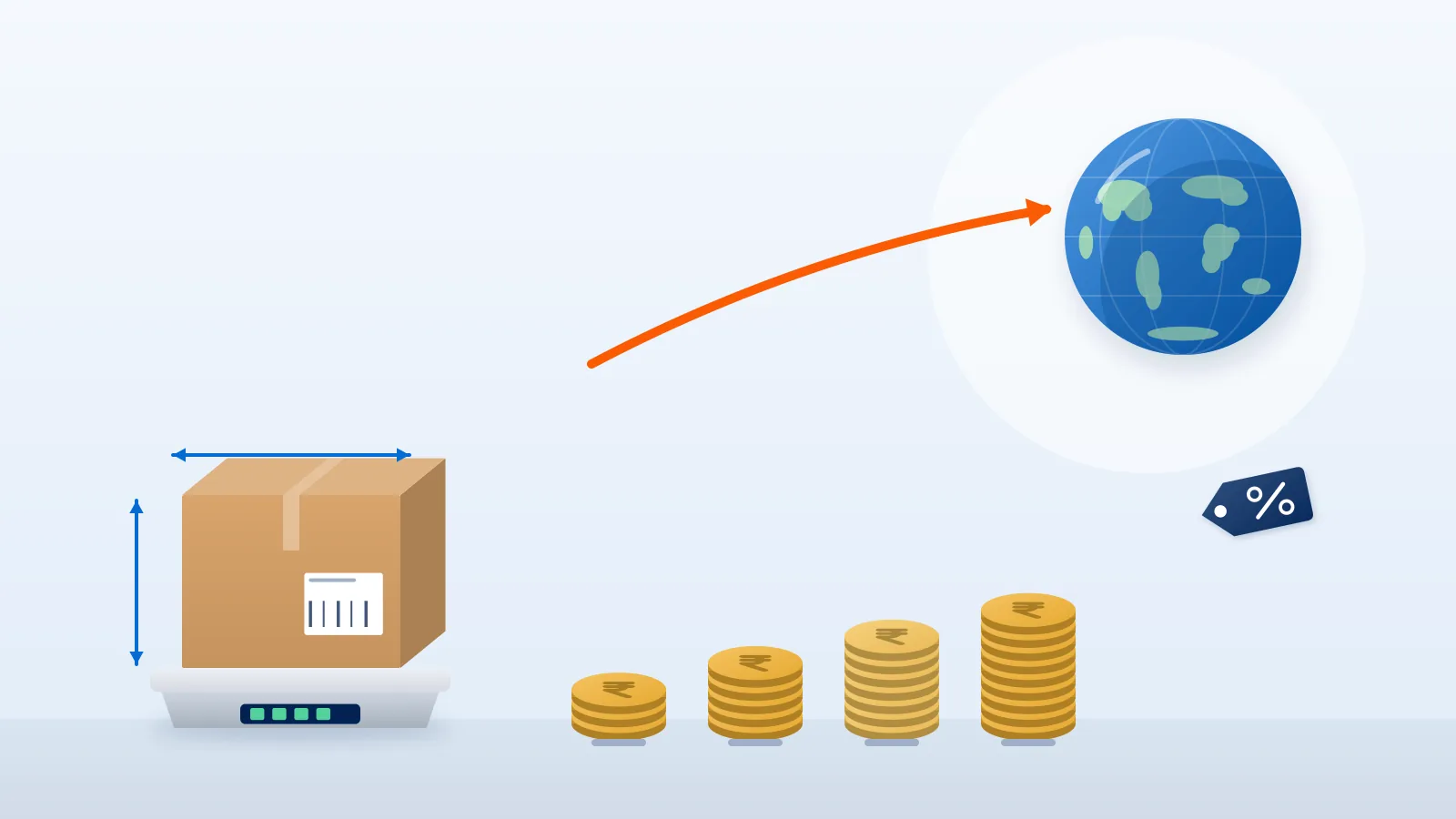
An overseas order looks wonderful until the courier bill arrives. A seller in Moradabad ships a brass lamp to a buyer in Toronto, quotes shipping from a rough figure she saw online, and finds the real charge is almost double because the box was large and light, a fuel surcharge applied, and the buyer later refused to pay duty on arrival.
International shipping cost from India is not one number. It is a stack of separate charges, some paid by you and some by the buyer. This guide breaks the stack into parts so you can price overseas orders without losing money. It assumes you already know the basics of international shipping from India; here we focus on the money.
The cost stack, line by line
| Component | Paid by | What drives it |
|---|---|---|
| Base freight | Seller (usually) | Chargeable weight and destination zone |
| Fuel surcharge | Seller | A percentage the courier revises periodically |
| Remote or out-of-delivery-area charge | Seller | The delivery postcode |
| Oversize or heavy-piece charges | Seller | Very long, heavy or irregular boxes |
| Export clearance charges | Seller | Courier or broker handling at origin, where charged |
| Insurance or declared-value cover | Seller (optional) | Value of goods |
| Import duty and taxes | Buyer or seller, depending on terms | Destination country, HS code, value |
| Duty handling or disbursement fee | Whoever pays the duty | Courier fee for advancing duty to customs |
| Returns or return-to-origin | Seller | Refused, undeliverable or returned parcels |
| GST on courier charges | Seller | Applied on the courier’s service invoice |
Not every courier uses every line, and names differ. The point is to ask for each one before you quote, rather than discovering them on the invoice.
Chargeable weight: where most surprises start
International couriers charge on chargeable weight, which is the higher of the actual weight and the volumetric weight. Volumetric weight is worked out from the box:
Volumetric weight (kg) = length × breadth × height (cm) ÷ divisor
Express couriers commonly use a divisor of 5,000 for centimetres and kilograms, but it varies by courier and service, so check the rate card for the exact service you book. Rates are also usually set in weight steps (for example by the half kilogram), so a parcel just over a step pays for the next one.
A worked example
These numbers are an illustration, not quoted rates.
- Brass lamp packed in a 40 × 30 × 30 cm carton with bubble wrap
- Actual weight: 2.4 kg
- Volumetric weight at a 5,000 divisor: 40 × 30 × 30 ÷ 5,000 = 7.2 kg
- Chargeable weight: 7.2 kg, three times the actual weight
Repacking the lamp in a 35 × 25 × 25 cm carton with moulded inserts brings the volumetric weight to 4.4 kg. The lamp is the same; the bill is far smaller. Our guide to volumetric weight and shipping charges explains the method in more detail, and the same packing discipline applies internationally, only with higher stakes per kilogram.
Zones and destinations
Couriers group countries into zones, and each zone has its own rate per weight step. Neighbouring regions such as the Gulf or South-East Asia often sit in different zones from North America or Europe. Two habits help:
- Check zone and remote-area status before you accept an order. A town far from a major city can attract a remote-area charge even in a country whose main cities are routine.
- Keep a short table of your top destinations with the current rate for your three most common box sizes. Update it whenever the courier revises its rate card or fuel surcharge.
When comparing quotes from different services, compare like with like: the same chargeable weight, the same destination postcode and the same set of surcharges. Our guide on how to compare courier rates covers the method; it works internationally too.
Duties and taxes at the destination
Import duty and local taxes (VAT, GST or sales tax, depending on the country) are charged by the destination country’s customs, not by the courier. The amount depends on:
- the product’s classification (HS code) in that country’s tariff
- the declared value, and sometimes shipping and insurance costs added to it
- any trade agreement that lowers the duty for goods of Indian origin, if you can prove origin
- the country’s low-value threshold, if it has one
Low-value thresholds are where many sellers get caught out. They differ by country and they change. In the United States, for example, U.S. Customs and Border Protection’s e-commerce FAQ states that the de minimis exemption is suspended for merchandise valued at $800 or less from all countries, arriving by any mode including post. A pricing assumption that worked for American buyers a couple of years ago may not work now.
Do not guess duty rates. Ask your courier, a customs broker, or check the destination country’s official customs website for your product’s classification.
Selling to buyers abroad? With Courier Tales you can book international shipments from your dashboard: compare carriers for the destination, see an estimated price, and send the parcel to our warehouse, where it is re-measured before the final price is set.
DAP, DDP and the old “DDU”
The terms of shipment decide who pays the duties and taxes. The International Chamber of Commerce publishes the Incoterms 2020 rules, a set of eleven three-letter trade terms. Two matter most for parcels:
- DAP (Delivered at Place). You pay to get the goods to the buyer’s address; the buyer pays import duty and taxes on arrival. Couriers often still call this “DDU” (Delivered Duty Unpaid), an older term that is not one of the Incoterms 2020 rules.
- DDP (Delivered Duty Paid). You pay the shipping and the destination duty and taxes. The buyer pays nothing more at the door.
| DAP / “DDU” | DDP | |
|---|---|---|
| Buyer experience | May get a payment request before delivery | Parcel arrives with nothing to pay |
| Seller’s cash risk | Lower upfront, but refused parcels come back at your cost | Higher upfront; you carry duty cost |
| Pricing | Product + shipping | Product + shipping + estimated duty and taxes |
| Common for | Low-value parcels, B2B buyers used to importing | Consumer sales where a smooth delivery matters |
Strictly, Incoterms are written for business-to-business contracts, but couriers use DAP-style and DDP-style options for consumer parcels too. Whichever you choose, write it on the product page and at checkout. A buyer who is surprised by a duty demand often refuses the parcel, and then you pay to get it back.
The Indian side: GST on exports
Exports of goods are zero-rated under GST. A registered exporter can either ship under a Letter of Undertaking without paying IGST, or pay IGST and claim a refund. The GST circular on LUTs says an LUT stays valid for the financial year in which it is filed. The LUT route avoids cash being locked in refunds; your CA should confirm which suits you. The courier’s own service charges carry GST on their invoice as usual. For the paperwork behind all this, see our guide to export shipment documents.
Pricing overseas orders without losing money
A simple way to build an overseas price:
- Start with your domestic landed cost of the product, including packaging.
- Add shipping at chargeable weight for the destination zone, plus the surcharges your courier applies.
- Decide DAP or DDP. For DDP, add estimated duty and taxes for the destination and a small buffer for rate changes.
- Add a returns allowance. International returns are expensive; even a small percentage of refused or returned parcels eats margin.
- Add payment costs. Cross-border card and wallet payments usually carry higher fees and currency conversion margins than domestic payments.
- Round and test. Check the final price against what similar products sell for in that country.
Sellers often set a minimum order value for international buyers, offer only a few compact products abroad, or charge shipping at checkout by destination. Each of these protects margin better than a flat “worldwide shipping” price.
Ways to bring the cost down
- Right-size every box and use inserts instead of air.
- Ship sets rather than singles so one shipping charge covers more value.
- Classify correctly. A wrong HS code can mean a higher duty or a customs hold that costs storage.
- Write a clear invoice so parcels clear first time.
- Watch refusal rates by country and stop offering DAP where buyers keep refusing duty payments.
For a broader view of selling overseas, including channels and payments, read our guide on how to sell abroad as a small business.
Final thoughts
The sellers who make international orders profitable are the ones who price from the full cost stack: chargeable weight, zone, surcharges, duties, returns and payment fees. Build that stack once for your main products and destinations, keep it updated, and overseas orders stop being a gamble.
When you are ready to ship beyond India, Create your Courier Tales account and check international carriers and estimated prices for your destination from the dashboard.
Frequently asked questions
How is international courier shipping cost calculated?
The base charge depends on the chargeable weight and the destination zone. Chargeable weight is the higher of the actual weight and the volumetric weight worked out from the box dimensions. Surcharges such as fuel, remote area and duty handling are added on top, and duties and taxes at the destination are separate.
What volumetric divisor do international couriers use?
Express couriers commonly divide length x breadth x height in centimetres by 5,000, but the divisor can differ by courier and service. Always read the rate card for the service you book, because a different divisor changes the chargeable weight of every bulky parcel.
Who pays customs duty on an international parcel?
It depends on the terms agreed for the shipment. Under DAP-style terms the receiver pays duties and taxes at the destination, while under DDP the seller pays them. Tell the buyer clearly at checkout which applies so the parcel is not refused on arrival.
Is customs duty charged on every parcel abroad?
Not always. Many countries have a value below which small parcels are not charged duty, but these thresholds differ widely and change. The United States, for example, suspended its de minimis exemption for low-value shipments from all countries, so check the current rules for each destination you sell to.
Do I pay GST on international shipments from India?
Exports of goods are zero-rated, so a registered exporter can ship under a Letter of Undertaking without paying IGST, or pay IGST and claim a refund. GST is still charged on the courier's own service charges as per their invoice. Confirm your treatment with a CA.
Sources
- Incoterms 2020, International Chamber of Commerce (accessed 2 November 2026)
- E-Commerce Frequently Asked Questions, U.S. Customs and Border Protection (accessed 2 November 2026)
- Circular No. 8/8/2017-GST: furnishing of Bond/Letter of Undertaking for exports, GST Council (accessed 2 November 2026)
Courier, marketplace and tax rules change. Check the current terms with your courier, marketplace or adviser before relying on them.