
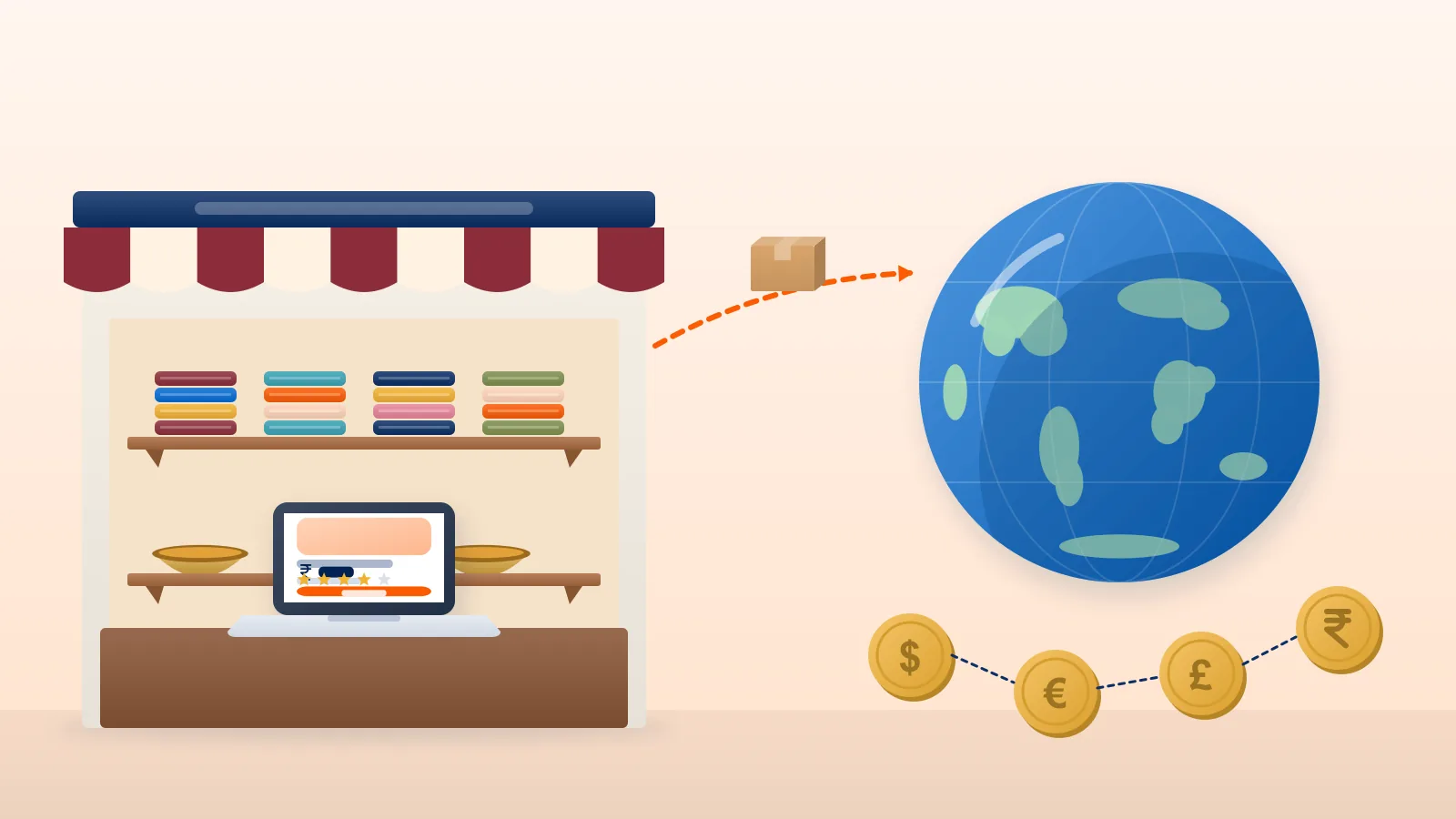
A seller in Bhagalpur who weaves tussar silk stoles may sell them for a few hundred rupees locally and for several times that to a buyer in London who has never seen anything like them. That gap is why so many small Indian businesses look abroad. The gap is real, but so are the costs between the loom and the London doorstep.
This guide is for small businesses that already sell in India and want to sell abroad from India without hiring an export team. It covers which products and markets to start with, where to sell, how to get paid, how duties affect your price, and how to handle returns. For registrations such as IEC, read our guide on how to start exporting from India first.
Step 1: Check your product is export-friendly
Some products travel well across borders; others are a struggle. Score yours honestly:
| Question | Good sign | Warning sign |
|---|---|---|
| Value for its size and weight? | High price, small box | Bulky, low price |
| Fragile? | Textiles, metalware, leather | Glass, ceramics, liquids |
| Regulated at the destination? | Clothing, decor, accessories | Food, cosmetics, supplements, medicines, plant material |
| Is it different from what buyers can get locally? | Handmade, regional, hard to find | Generic, mass-produced |
| Sizing or fit risk? | One size, accessories | Fitted clothing, footwear |
A ₹2,500 pashmina stole in a slim pouch can absorb international shipping. A ₹300 ceramic mug in a big box usually cannot. If your top-selling product fails this test, offer a different product abroad rather than forcing it.
Step 2: Pick one or two countries, not the world
“We ship worldwide” sounds ambitious, but each country has its own duties, rules, delivery costs and buyer expectations. Start with one or two markets where:
- there is demand for your category (look for overseas sellers of similar products and their reviews)
- there is an Indian diaspora that already knows the product, if your product is culturally specific
- shipping costs and duties keep your final price competitive
- you can communicate with buyers easily, including time zones
Once one market works, add the next. Your second country is much easier than your first.
Step 3: Choose where you will sell
| Channel | How it works | Strengths | Watch out for |
|---|---|---|---|
| Global marketplace | List on a marketplace’s site in the destination country | Buyers are already searching; built-in trust | Fees, account rules, competition on price |
| Handmade or niche marketplace | List on a platform focused on crafts or a category | Buyers who value handmade | Category rules, fees |
| Your own website | Sell on your store with international shipping and payments | Your brand, your data, repeat buyers | You must bring traffic from abroad |
| Social and messaging | Sell through Instagram and WhatsApp, often to diaspora buyers | Personal relationships, low setup | Hard to scale; payments need care |
| Overseas shops (B2B) | Supply boutiques or importers in bulk | Larger orders, fewer parcels | Longer sales cycle, trade terms |
Read each marketplace’s current seller terms yourself before signing up, especially fees, shipping rules and who handles returns. If you sell on several channels at once, our guide on multichannel order management helps keep stock and orders in one place.
Step 4: Set up international payments
Getting paid abroad is different from collecting UPI or COD at home. Things to decide:
- Payment method. A payment gateway or platform that accepts international cards and wallets for consumer orders, or bank transfers for trade orders.
- Currency. Price in the buyer’s currency where your platform allows it. Buyers trust prices they do not have to convert.
- Fees and conversion. Cross-border payments usually cost more than domestic ones. Put this into your price.
- Banking channel. Export proceeds should come into your bank account through proper banking channels so they can be matched to each shipment. Your bank or payment provider can tell you which documents it needs and the time limits that apply under RBI rules.
Talk to your CA early about how export income, GST under LUT and bank documentation fit together.
Ready to ship your first overseas orders? With Courier Tales you can book international shipments from your dashboard: compare carriers for the destination, see an estimated price, and send the parcel to our warehouse, where it is re-measured before the final price is set.
Step 5: Price for shipping and duties
International pricing has to include more than the product and the courier charge:
- shipping at chargeable weight for the destination zone, with surcharges
- import duty and taxes in the buyer’s country, if you sell on duty-paid terms
- payment fees and currency conversion
- a returns allowance
- marketplace commission, if any
Duty rules change, and the change can hit a whole market at once. U.S. Customs and Border Protection says its suspension of the de minimis exemption applies to goods valued at $800 or less from all countries, so even small parcels to American buyers now go through a customs entry. Sellers whose prices assumed low-value parcels would pass without duty have had to rethink.
Decide whether you sell on duty-paid (DDP) or receiver-pays (DAP-style) terms for each country, and say so clearly on the product page. Our guide to international shipping costs from India walks through the full cost stack with a worked example.
Step 6: Get the shipping and paperwork right
For most small sellers, international courier is the practical way to send consumer orders: door to door, with the courier handling export clearance. Since 1 April 2026, CBIC has removed the earlier ₹10 lakh value cap per consignment on commercial courier exports, so higher-value orders can also go by courier rather than being pushed to cargo.
What you need to have ready for each order:
- a commercial invoice with a clear description, HS code and the real value
- a packing list that matches it
- your IEC, GST and AD code details for the courier
- the buyer’s full address, phone number and any import ID their country asks for
DGFT describes the IEC as mandatory for exporting goods unless a specific exemption applies. Our export shipment documents checklist covers each item in detail.
Pack for a longer journey than a domestic parcel. International parcels pass through more hands, sorting systems and climates. Double-box fragile items, seal textiles in moisture-proof bags, and keep the box as small as the product allows.
Step 7: Write a returns policy you can afford
Returns are the part most small exporters underestimate. A return means a second international shipment, often a customs process on re-entry, and goods that may not be fit to resell.
A workable policy for a small exporter:
- Accept returns only for damaged, defective or wrong items, and say so before purchase.
- Ask for photos first. Many issues can be solved with a partial refund or a replacement.
- For low-value items, consider refunding without asking for the item back. The return shipping can cost more than the product.
- Reduce size-related returns with detailed size charts and measurements in centimetres and inches.
When goods do come back, keep the original export documents. CBIC’s 2026 reforms introduced a risk-based approach for re-importing returned or rejected goods, including e-commerce exports, with a dedicated return module in the courier clearance system. Your courier or broker will still need the original shipment details.
A 90-day plan to start
- Days 1–30: Pick two or three export-friendly products and one country. Get your IEC, LUT and AD code in place with your CA and bank. Photograph the products for overseas buyers, with sizes in both units.
- Days 31–60: List on one channel. Work out the full cost stack for your box sizes. Write your shipping, duty and returns policy. Send one test parcel to a friend or relative abroad and note what happened.
- Days 61–90: Take real orders. Track every cost per order and every customer question. Decide whether to add a second country, a second channel, or more products in the same market.
Final thoughts
Selling abroad does not need a big export house. It needs the right products, one market at a time, honest pricing that includes duties and returns, and paperwork that is right the first time. Small Indian brands with something distinctive to offer are well placed to do this.
When you are ready to send your first parcels overseas, Create your Courier Tales account and book your first international shipment from the dashboard.
Frequently asked questions
Can a small business in India sell products abroad?
Yes. Small sellers export through global marketplaces, their own websites, social media and direct deals with overseas shops. You need an Importer-Exporter Code from DGFT for exporting goods, plus the GST and bank set-up your CA advises. Start with a few products and one or two countries.
Should I sell abroad on a marketplace or my own website?
A global marketplace brings buyers who are already searching, in return for fees and the marketplace's rules. Your own website keeps the customer relationship but needs you to bring traffic from that country. Many small sellers test demand on a marketplace first and add their own site later.
How do I receive payments from overseas buyers?
Through a payment gateway or platform that supports international payments, or by bank transfer for larger trade orders. Export proceeds should come into your bank account through proper banking channels so they can be matched to your shipments. Ask your bank which documents it needs for each receipt.
How should I handle returns from international buyers?
Write a clear policy before you take orders: which products can be returned, who pays return shipping, and whether you offer a refund without return for low-value items. Returning a parcel to India is costly and involves customs, so many sellers limit returns to damaged or wrong items.
Which products are easiest to sell abroad from India?
Products that are light and compact for their price, not fragile, not regulated, and not easily found locally abroad tend to work well. Textiles, handicrafts, jewellery and home decor are common examples. Food, cosmetics and medicines often need extra certificates in the destination country.
Sources
- IEC Profile Management, Directorate General of Foreign Trade, Government of India (accessed 2 November 2026)
- CBIC operationalises comprehensive reforms for e-commerce exports and courier trade from April 1, 2026, Press Information Bureau, Ministry of Finance (accessed 2 November 2026)
- E-Commerce Frequently Asked Questions, U.S. Customs and Border Protection (accessed 2 November 2026)
Courier, marketplace and tax rules change. Check the current terms with your courier, marketplace or adviser before relying on them.