
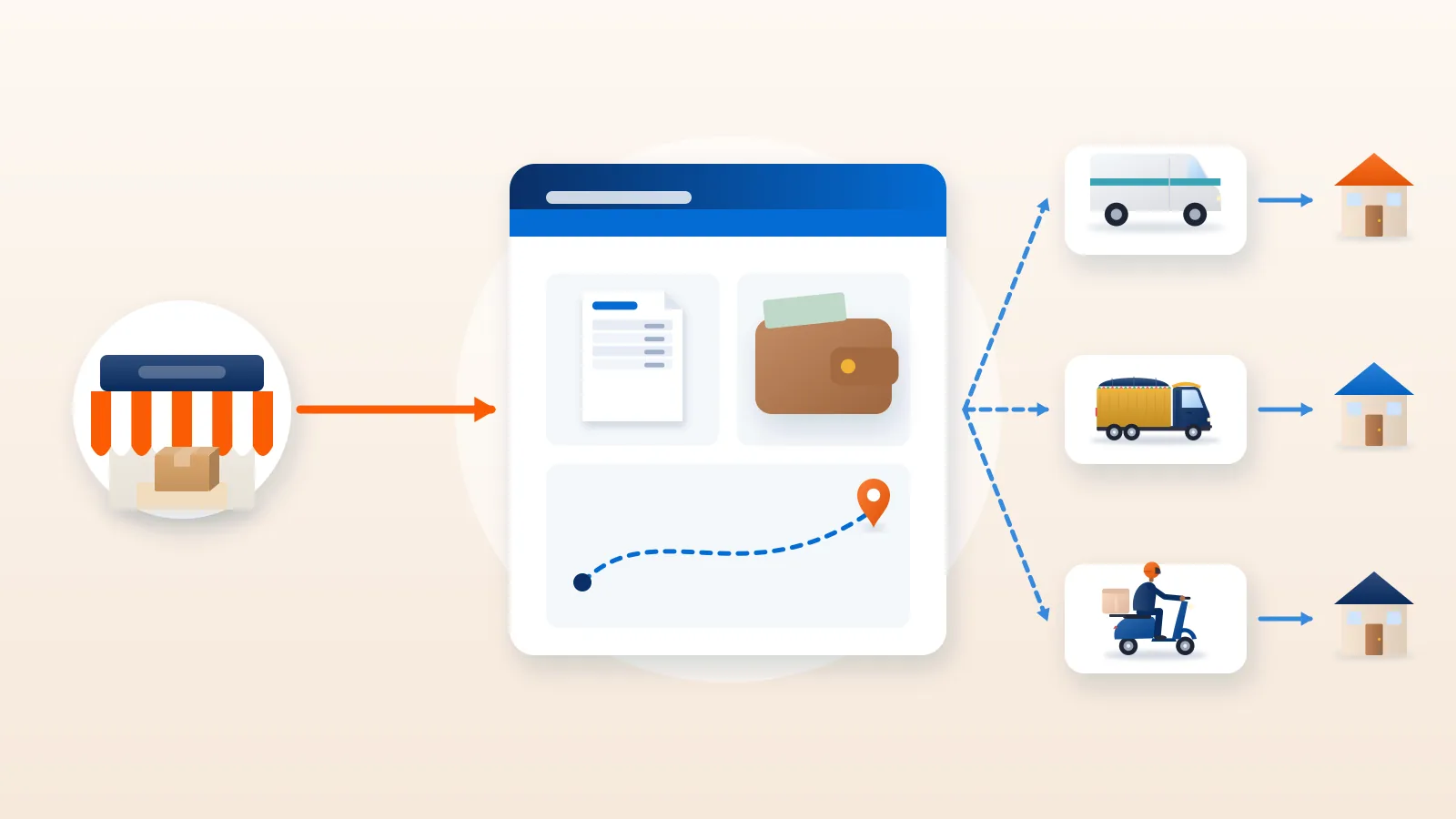
You have probably heard sellers say they ship “through an aggregator” rather than directly with a courier. The idea is simple enough: one account, several couriers. But what actually happens between your dashboard and the courier’s truck is less obvious, and it explains most of the questions sellers have later, about rates, wallet adjustments, COD timing and why tracking updates sometimes lag.
This guide explains what a shipping aggregator is and how its main parts work: contracts, rate cards, wallets, settlements, tracking and disputes. If you already understand the mechanics and want to pick one, our guide on how to choose a courier aggregator has a weighted checklist and trial plan. If you are weighing a direct courier contract instead, see courier aggregator vs direct courier account.
A shipping aggregator, defined
A shipping aggregator (also called a courier aggregator or shipping platform) is a business that holds commercial arrangements with several courier companies and gives sellers one system to use all of them. The seller books, prints labels, tracks, handles failed deliveries and pays through the aggregator. The courier does the physical work: pickup, sorting, transport and delivery.
So there are two relationships in every shipment:
- Seller and aggregator. Your account, your rates, your wallet, your support tickets and the terms you accepted at sign-up.
- Aggregator and courier. The aggregator’s contract, its rates with the courier, the technical integration and the escalation route.
You normally never sign anything with the courier. That is the main practical difference from a direct account.
How one order flows through an aggregator
| Step | What you do | What happens behind the dashboard |
|---|---|---|
| 1. Order arrives | Import from your store or upload a file | Order is checked for address, pincode, weight and dimensions |
| 2. Compare | See couriers that serve the route | Each courier’s serviceability for the pickup and delivery pincodes is checked, and your rate plan is applied |
| 3. Book | Choose a courier, or let your priority decide | The aggregator sends the booking to the courier’s system and receives an AWB number |
| 4. Pay | Charge leaves your wallet | The estimated charge is deducted, usually including GST |
| 5. Label and pickup | Print label and manifest | The courier gets a pickup request for your address |
| 6. Track | Watch one timeline | Courier status updates are received and mapped to common statuses |
| 7. Exceptions | Act on failed attempts and disputes | Your instructions are passed to the courier; its responses come back |
| 8. Settle | Receive COD and see adjustments | Courier remittances and invoices are reconciled against shipments |
Each step is covered below.
Contracts: whose terms apply
Because your agreement is with the aggregator, its terms govern your shipments: liability for loss or damage, claim limits, dispute windows, the COD remittance cycle, refund of unused wallet balance, and how price changes are notified. The aggregator in turn works within the courier’s terms, for example which items the courier refuses or how it measures weight.
In practice that means two things. First, read the aggregator’s merchant agreement, not just its pricing page. Second, expect some answers to take a little longer, because issues such as a lost parcel or a disputed weight pass through the aggregator to the courier and back.
Rate cards: how your price is built
Courier pricing has layers. Delhivery’s published rate card, for example, describes charges that depend on the zone (based on pickup and delivery pincodes), the weight slab (based on the higher of dead weight and volumetric weight), the transport mode and the shipment type (forward, RTO or return), with a COD charge on cash-on-delivery shipments and a destination city surcharge for certain cities (Delhivery rate card).
An aggregator negotiates its own rates with each courier and then publishes rate plans for sellers. Your price for a shipment depends on:
- Zone: how far apart the pickup and delivery pincodes are, and whether either is a special area.
- Chargeable weight: the higher of actual and volumetric weight, rounded up to the courier’s slab. See our guide to volumetric weight and shipping charges.
- Mode: surface or air, where both are offered.
- Payment type: COD adds a charge.
- Surcharges: such as fuel, remote area or peak charges, where they apply.
- GST: added to shipping charges.
- Your plan: some platforms offer several plans with different rates or terms.
That is why two couriers can show different prices for the same parcel, and why the same courier can cost more through one platform than another. It is also why your own figures for weight and size matter so much: they decide the slab before the parcel is even picked up.
Wallets: prepaid shipping
Most aggregators use a prepaid wallet. You recharge it, and the estimated charge for each shipment is deducted at booking. If the courier refuses the booking, or you cancel before pickup, the charge is normally returned to the wallet.
The amount deducted at booking is not always final. Later entries can include:
- Weight adjustments, when the courier records a higher weight or larger size than declared.
- RTO charges, when a parcel returns to you.
- Reversals, when a dispute is accepted or a booking is cancelled.
A clear wallet statement lists every debit and credit against an AWB, so you can match it to your shipments. On Courier Tales, for example, weight disputes appear in the dashboard, and you have 48 hours to respond with evidence, one dispute per AWB.
COD settlements: how the cash travels
Cash on delivery adds a second flow of money, in the opposite direction:
- The courier’s delivery executive collects cash or UPI payment from the buyer.
- The courier remits COD collections on its own cycle. With a direct account, the courier pays the seller. Delhivery’s help centre, for example, says COD is transferred within 48 hours, but only when the seller’s wallet balance is positive (Delhivery COD remittance).
- Through an aggregator, the courier remits to the aggregator, which reconciles collections against its shipments.
- The aggregator pays you on the remittance plan you chose, with a report listing the AWBs in each payment.
Plans differ between platforms. On Courier Tales the default plan remits seven days after delivery (D+7); faster plans may carry a fee, and you can use COD money to recharge your shipping wallet. Whatever platform you use, the gap between delivery and remittance affects your working capital. Our guide on COD settlement and cash flow works through an example.
Want to see the mechanics in practice? Courier Tales shows the integrated couriers that serve each route with estimated charges, deducts each shipment from a prepaid wallet, and lets you follow COD collections against every order.
Tracking: one timeline from many sources
Each courier has its own status codes and its own way of sending updates. An aggregator receives these updates through its integrations with the couriers, maps them to a common set of statuses (booked, picked up, in transit, out for delivery, delivered, failed attempt, RTO), and shows one timeline per shipment.
Two consequences follow. First, you and your buyer get one tracking link, whatever the courier. Second, updates can take a little while to appear, because they travel from the courier’s scan to its system, then to the aggregator. If a status looks stale, check the time of the last event before assuming the parcel is stuck.
Failed deliveries and returns
When a delivery attempt fails, the courier records a reason, and the aggregator lists it as a non-delivery report (NDR). Your choice of action (reattempt, updated phone or address, or return) is passed back to the courier. If no action is taken, or the buyer refuses, the parcel usually heads back as RTO. The aggregator keeps it visible until it reaches your pickup address.
What an aggregator is, and is not
| An aggregator is | An aggregator is not |
|---|---|
| A single system for booking, tracking and billing across several couriers | A courier network with its own trucks and hubs |
| Your contract partner for shipping terms | A way to avoid courier rules on restricted items or weights |
| A source of comparison between couriers on each route | A promise that every pincode is served |
| A layer that consolidates support and disputes | A replacement for checking your own data |
If the benefits fit how you sell, our guide on why sellers use a multi-courier shipping platform covers the signs you have outgrown a single courier.
Final thoughts
A shipping aggregator sits between you and several couriers. It holds the courier contracts, turns their rate cards into your rate plan, runs a wallet for your charges, settles COD on its own cycle and combines courier updates into one tracking timeline. Understanding those mechanics makes it much easier to read your wallet statement, plan your cash and ask the right questions.
Create your Courier Tales account to compare couriers on each route, ship from one wallet and track every order in one place.
Frequently asked questions
Is a shipping aggregator the same as a courier company?
No. A courier company owns or runs the pickup network, hubs, line-haul and delivery staff. A shipping aggregator is a platform that connects sellers to several such couriers, and handles booking, labels, tracking, billing and support across them.
Who is responsible if a parcel is lost when I ship through an aggregator?
The parcel is physically with the courier, but your agreement is with the aggregator, so you raise the claim with the aggregator, which takes it up with the courier. Read the aggregator's terms on liability, claim limits and timelines before you ship high-value goods.
Why does my wallet balance sometimes change after a shipment is delivered?
The charge at booking is based on the weight and dimensions you entered. If the courier later records a higher chargeable weight, or the parcel returns as RTO, the platform may make an adjustment. A good platform shows each adjustment against the AWB, with a way to dispute it.
How does COD money reach me through an aggregator?
The courier collects cash from the buyer and remits it on its own cycle. The aggregator then reconciles those collections against its shipments and pays sellers on the remittance plan they chose. Ask for a remittance report that lists every AWB in each payment.
Do I need a GST number to use a shipping aggregator?
It depends on the platform and on your own registration needs. Many platforms ask for business KYC documents, which may include GST details where applicable. Check the platform's KYC list and confirm your GST position with a CA.
Sources
- Rate Card, Delhivery One Help Center (accessed 2 November 2026)
- COD Remittance, Delhivery One Help Center (accessed 2 November 2026)
Courier, marketplace and tax rules change. Check the current terms with your courier, marketplace or adviser before relying on them.