
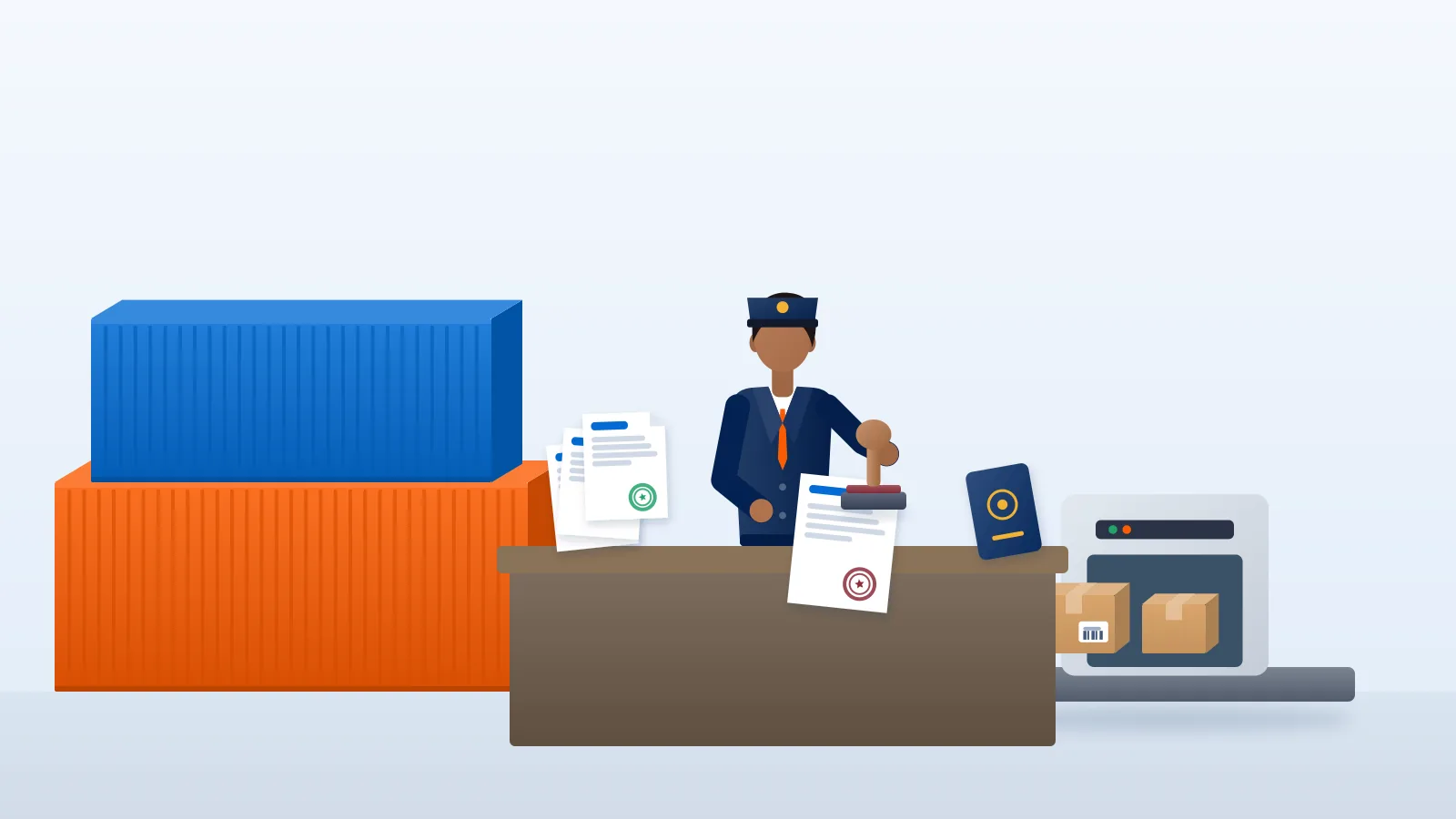
Every international shipment is cleared twice. Indian customs clears it out of the country, and the destination country’s customs clears it in. A parcel can pass the first step smoothly and still stop at the second, or the other way round.
This guide explains customs clearance for international shipments from the seller’s side: what happens at each end, who files what, why parcels get held, and what to do when a buyer sends something back. It does not replace advice from a customs broker. Rules differ by product and destination, and they change, so confirm specifics for your goods. For the paperwork itself, see our export shipment documents checklist.
Two clearances, two sets of rules
| Export clearance (India) | Import clearance (destination) | |
|---|---|---|
| Who controls it | Indian customs (CBIC) | The destination country’s customs |
| Who files | Authorised courier (courier mode) or your customs broker (cargo mode) | The courier or the buyer’s broker |
| Main question | Is this export correctly declared and allowed? | What duty and tax is due, and is the product allowed in? |
| Who pays | Seller, for any origin charges | Buyer or seller, depending on the terms of shipment |
Export clearance by courier
Most online sellers send overseas orders as courier shipments. In this mode you hand the parcel and documents to the courier, and the courier deals with customs at an International Courier Terminal.
Step 1: The courier files the shipping bill
Under the courier regulations, the authorised courier enters the export on a courier shipping bill: CSB-III for documents, CSB-IV for gifts, samples and prototypes, and CSB-V for commercial goods involving foreign exchange. The filing happens on the Express Cargo Clearance System (ECCS). For a CSB-V the courier needs your IEC, AD code, GSTIN, invoice value, HS code and whether you paid IGST or exported under bond or LUT. If any of these are missing, this is where the shipment waits.
Step 2: Assessment, screening and examination
Customs uses a risk-based system to decide which shipments to look at closely. Many pass on the strength of the declaration; others are screened or opened for examination. The regulations require the courier to present export goods to the proper officer for inspection, screening, examination and assessment as directed.
Step 3: Let Export Order
Once customs is satisfied, it grants a Let Export Order (LEO). The goods can then be loaded for export. The courier regulations also allow customs to detain export goods that stay in the customs area for more than seven days without being exported, unless the delay is permitted, so a shipment stuck on a missing document is not just slow; it is at risk.
What changed in 2026
From 1 April 2026, CBIC removed the earlier ₹10 lakh value cap per consignment for commercial courier exports. Before that, higher-value orders had to move to air or sea cargo because of value alone. The same reforms simplified re-import of returned or rejected goods, which we cover below.
Export benefits on courier shipments
If you claim duty drawback, RoDTEP or RoSCTL, the process runs slightly differently. CBIC amended the courier regulations in 2024 so that, where these benefits are claimed, the authorised courier files the shipping bill on ICEGATE and it is processed on the Indian Customs EDI System, while the goods are still handled and examined at the courier terminal. Tell your courier before pickup if you intend to claim a benefit, because it decides how the shipping bill is filed.
Export clearance as cargo
Larger or heavier consignments often go as air or sea cargo instead. Here a licensed customs broker files the shipping bill on ICEGATE, the goods are brought to the airport, port or container freight station, and customs assesses, examines where needed, and grants the LEO. The steps are similar; the main difference is that you work with a freight forwarder and a broker rather than a single courier. Our comparison of international courier, air cargo and sea freight explains when cargo makes sense.
Sending orders overseas? With Courier Tales you can book international shipments from your dashboard: compare carriers for the destination, see an estimated price, and send the parcel to our warehouse, where it is re-measured before the final price is set.
Import clearance at the destination
When the parcel lands, the destination customs looks at the declared description, value and classification and decides what duty and taxes are due. What happens next depends on the terms of shipment:
- Receiver pays (DAP-style). The courier asks the buyer to pay duty and taxes before delivery. If the buyer refuses, the parcel waits, and may eventually come back to you.
- Seller pays (DDP). The courier charges the duty to your account and delivers without asking the buyer for money.
Destination rules can change quickly. U.S. Customs and Border Protection’s e-commerce FAQ, for example, says the suspension of the de minimis exemption applies to merchandise valued at $800 or less from all countries, arriving by all modes including post, and that such shipments must now go through formal or informal entry. A low-value parcel to an American buyer is now a customs entry like any other. Check the current position for each country you sell to; our guide to international shipping costs from India covers how duties feed into pricing.
Why shipments get held, and what to do
| Reason for a hold | At which end | What usually resolves it |
|---|---|---|
| Missing IEC, AD code or GSTIN details | India | Share the details with the courier; register the AD code if not done |
| Vague description (“gift”, “parts”, “items”) | Either | Send a corrected invoice with a plain description |
| Value looks too low for the product | Either | Provide proof of payment or a price list |
| HS code missing or doubtful | Either | Confirm the classification with a broker |
| Product needs a certificate or licence | Either | Provide the certificate, or the shipment may be refused |
| Duty unpaid by receiver | Destination | Contact the buyer; agree who pays; consider DDP for that country |
| Receiver’s import ID or contact missing | Destination | Get the details from the buyer and pass them to the courier |
When tracking shows a customs hold:
- Read the exact status on the courier’s tracking. Our guide to tracking a courier by AWB explains how to read status lines.
- Contact the courier’s international desk with the AWB number and ask what customs needs.
- Reply with documents the same day. Storage charges can start after a short period at many terminals.
- Tell the buyer what is happening and what, if anything, they need to do.
- Record the cause so you can fix your process for the next shipment.
Returns and re-import
International returns are where clearance gets complicated, because goods that left India under an export declaration have to come back in. CBIC’s April 2026 reforms address this directly. According to the PIB release, re-import of returned or rejected goods, including e-commerce exports, now follows a risk-based approach instead of consignment-wise verification, and a dedicated return module has been added to the Express Cargo Clearance System.
For a smooth re-import, keep:
- the original courier shipping bill number and date
- the original invoice and AWB
- the return reason and any messages with the buyer
- proof that the returned goods are the same goods that were exported
Whether duty or GST implications arise on re-import depends on the case and the benefits you claimed on export, so check with your CA or broker before you accept a return.
Final thoughts
Customs clearance is mostly predictable when your declaration is accurate and complete. Most holds trace back to a vague description, a value that does not add up, or a missing registration. Fix those at source and your international parcels move through both clearances with far fewer surprises.
If you are adding buyers abroad to your domestic business, Create your Courier Tales account and book your first international shipment from the dashboard.
Frequently asked questions
How long does customs clearance take for an international shipment?
There is no fixed time. A parcel with complete, consistent documents that is not selected for examination usually clears without much delay, while one with a query can wait until the query is answered. Your courier's tracking will show when the shipment is held and why.
Do I need a customs broker to export by courier?
Usually not. For courier exports, the authorised courier files the courier shipping bill with customs on your behalf, using the IEC, invoice and other details you provide. For air or sea cargo, a licensed customs broker normally files the shipping bill for you.
What is a Let Export Order?
It is customs' permission for the goods to be exported, given once the shipping bill has been assessed and any examination is complete. After it is granted, the goods can be loaded for export. If a shipment is held before this stage, the courier or broker will ask you for whatever customs needs.
What happens if my parcel is held in customs abroad?
The destination customs usually needs more information, a duty payment, or a document such as an import ID from the receiver. The courier contacts the receiver or the shipper, depending on the terms of shipment. Reply quickly, because storage charges can build up and unclaimed parcels may be returned or disposed of.
Can I bring back an export parcel the buyer returned?
Yes, returned or rejected exports can be re-imported. From April 2026, CBIC says it has adopted a risk-based approach for re-importing returned goods, including e-commerce exports, with a dedicated return module in its courier clearance system. Keep the original shipping bill and invoice details, because the re-import is matched against them.
Sources
- Courier Imports and Exports (Electronic Declaration and Processing) Regulations, 2010 (updated text with forms), Central Board of Indirect Taxes and Customs (accessed 2 November 2026)
- CBIC operationalises comprehensive reforms for e-commerce exports and courier trade from April 1, 2026, Press Information Bureau, Ministry of Finance (accessed 2 November 2026)
- CBIC extends export-related benefits for exports made through courier mode, Press Information Bureau, Ministry of Finance (accessed 2 November 2026)
- E-Commerce Frequently Asked Questions, U.S. Customs and Border Protection (accessed 2 November 2026)
Courier, marketplace and tax rules change. Check the current terms with your courier, marketplace or adviser before relying on them.