
Returns are the part of e-commerce that most sellers plan last. The first few feel like one-off annoyances. Then the festive sale ends, forty parcels come back in a week, and you realise you have no idea what each one cost or why it happened.
This guide is about controlling that. It shows how to work out the real cost of a return, how to find the reasons behind your returns, and how to design a policy and a back-office process that keeps the cost down without making buyers feel trapped. If you need the basics of how a return is collected first, read what a reverse pickup is. For the buyer-facing side (messages, return forms, refund updates), see our guide to the returns customer experience.
What reverse logistics covers
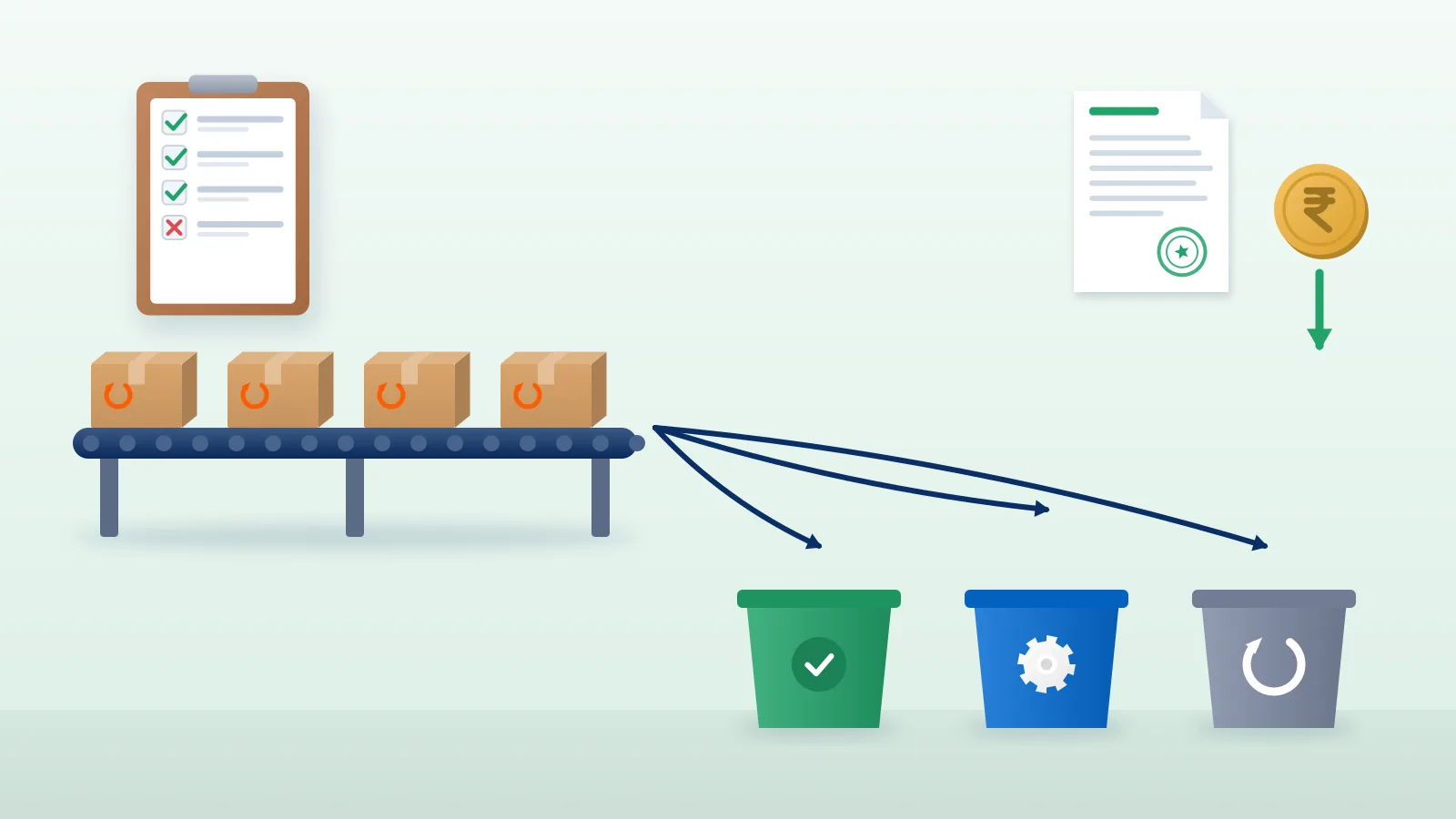
Reverse logistics is every step between “I want to return this” and the moment the product is either back on your shelf or written off:
- Return request and approval
- Collection from the buyer (reverse pickup or drop-off)
- Transit back to your return address
- Receiving and inspection
- Disposition: restock, repair, sell as seconds, return to supplier or scrap
- Refund, exchange or store credit
- Recording the reason so you can fix it
RTO parcels (orders that were never delivered) also come back through your door, but they have different causes and fixes. Keep them in a separate count. Our RTO reduction playbook deals with those.
The real cost of one return
Most sellers count only the reverse shipping charge. The full cost is wider.
| Cost component | Notes |
|---|---|
| Forward shipping already paid | Rarely recoverable from the courier |
| Reverse shipping | Billed separately on chargeable weight; some couriers add the same city or zone surcharges that apply to forward shipments |
| COD-related charges on the original order | If the order was COD, those charges are already spent |
| Packaging | Replacement box, tags or polybags for restocking |
| Inspection and handling time | Unpacking, checking, photographing, updating stock |
| Refund processing | Payment gateway fees may not be returned on refunds; check your gateway’s terms |
| Value lost | Items that cannot be sold as new, sold at a discount, or scrapped |
| Customer service time | Calls and messages about the return |
On surcharges: Delhivery’s help centre, for example, says its destination city surcharges for select cities apply to forward, RTO and reverse (DTO) shipments alike. Check your own courier’s rate card for reverse pricing; do not assume it matches forward pricing.
A worked illustration
Take Kavya, who sells cotton kurtas from Jaipur at ₹1,199. Her product and packaging cost is ₹480. The figures below are illustrative, not quoted rates.
- Forward shipping already spent: ₹70
- Reverse pickup: ₹90
- New polybag and tag: ₹15
- Ten minutes of staff time: ₹25
- One in five returned kurtas comes back stained or worn and is sold at half price: average loss ₹120 per return
That is about ₹320 for each return, against a gross margin of roughly ₹650 on a kept order. If 15 out of every 100 orders come back, returns eat close to ₹4,800 of the margin on those 100 orders. Cutting the return rate to 10 saves around ₹1,600 per 100 orders, which can be more than a courier rate negotiation would save. For the forward side of this maths, see how to calculate your shipping cost per order.
Find out why products come back
You cannot cut returns you do not understand. Record a reason for every return, from a fixed list rather than typed notes, so you can count them.
| Reason code | What it usually points to | Typical fix |
|---|---|---|
| Size or fit | Size chart unclear or inconsistent | Measured size chart per product, “fits small” notes, model’s size in photos |
| Not as described / colour different | Photos edited too much, missing details | Natural-light photos, fabric close-ups, honest descriptions |
| Damaged in transit | Weak packing | Stronger box, corner protection, better filler |
| Wrong item sent | Picking error | SKU labels on shelves, scan or double-check before sealing |
| Defective | Supplier quality | Batch checks, supplier feedback, return-to-vendor terms |
| Changed mind | Impulse purchase, slow delivery | Faster dispatch, clearer expectations, exchange offers |
Review the counts every month by product and by reason. A single SKU with a high “size” rate is a product-page problem, not a returns problem. A spike in “damaged” after you changed box suppliers tells you exactly what to undo.
Design the policy around your products
A returns policy is a commercial document. It should be generous where generosity wins orders and firm where returns would simply transfer losses to you. Decide each of these explicitly:
- Return window. Long enough for the buyer to try the product, short enough that it is still sellable when it comes back. Pick a window that suits your category, for example 7 or 15 days from delivery, and state it plainly.
- Condition. Unused, with tags, in original packaging. Say what “unused” means for your product.
- Non-returnable items. Innerwear, cosmetics once opened, perishables, customised or made-to-order products, and similar. Accept them only if damaged or wrong.
- Who pays return shipping. You pay for your errors. For change-of-mind returns, choose between absorbing the cost, a fixed return fee, or no-cost exchanges with a fee on refunds.
- Refund method and timing. Original payment method, bank transfer for COD orders, or store credit. Say when the refund is processed (for example, after the item passes inspection).
- Exchange first. Offer an exchange before a refund for size and colour issues. It keeps the sale.
- Proof for damage claims. Ask for photos, or an unboxing video for high-value items, within a short time of delivery.
Indian consumer protection rules for e-commerce expect return, refund and exchange terms to be disclosed clearly to buyers, and marketplaces set their own return rules that you must follow on their channels. Have a lawyer review your policy wording, and keep it consistent across your website, marketplace listings and messages.
Build a back-office process
A good policy with no process still loses money. Set up these steps.
Approval rules
Write simple rules your team can apply without asking you: inside the window, category returnable, reason recorded, photos received for damage claims. Anything outside the rules goes to one person who decides.
Collection
Use a reverse pickup where the buyer should not have to travel (your error, high-value items) and where the pincode is covered. For low-value change-of-mind returns, consider buyer drop-off or a “keep it” refund when the reverse charge would exceed what you would recover.
Returns arriving every week? Book reverse pickups with Delhivery in eligible pincodes and follow them in the same dashboard as your forward orders.
Receiving and inspection
Open returned parcels on camera or in front of a second person, especially high-value items. Compare against the original order: right SKU, all parts, tags, condition. Photograph anything wrong before you contact the buyer. Some couriers offer checks at the buyer’s door as well; our guide to reverse pickup quality checks explains that practice.
Grading and disposition
Grade each item quickly so it does not sit in a corner for weeks:
- A: as new; restock immediately
- B: minor issue; repack, relabel or sell as open-box or seconds
- C: repairable; send for repair or back to the supplier
- D: unsellable; write off and record the loss
Speed matters. A kurta restocked in two days can be sold again in the same season. One found in a sack a month later may have missed it.
Refund
Refund promptly once the item passes inspection, and tell the buyer the moment you do. Slow refunds create more customer service work than the return itself.
Metrics to track every month
- Return rate overall and by SKU (returns ÷ delivered orders)
- Share of returns by reason code
- Average cost per return (use the table above)
- Days from return request to item received, and to refund
- Share of returned items restocked as A grade
- Exchange share (exchanges ÷ all returns)
Track RTO separately, as noted earlier. Mixing the two hides what is really going wrong.
Final thoughts
Returns will never be zero, and a seller who tries to make them zero by hiding the policy usually loses more in trust than they save. The sellers who control returns well do three things: they know what a return really costs, they fix the reason behind each one, and they run a process that gets good stock back on the shelf fast.
When you want forward shipments, reverse pickups and tracking in one place, create your Courier Tales account and manage every parcel, outgoing or returning, from one dashboard.
Frequently asked questions
What is reverse logistics in ecommerce?
Reverse logistics is everything that happens when a product travels back from the buyer to the seller: approving the return, collecting the parcel, inspecting it, deciding whether to restock, repair or write it off, and closing the refund or exchange. It is the mirror image of order fulfilment, and it usually costs more per unit.
How do I calculate the cost of a return?
Add the forward shipping you cannot recover, the reverse shipping charge, packaging, staff time for inspection and restocking, payment or refund processing costs, and the value lost if the item cannot be sold as new. Compare that total with your margin on the product to see which categories are worth the risk.
Should I charge buyers for returns?
Many sellers do not charge when the fault is theirs, such as a wrong, damaged or defective item. For change-of-mind returns, some charge a fixed return fee, or collect exchanges at no cost but charge for refunds. Whatever you choose, state it clearly before the buyer orders.
Which products should be non-returnable?
Sellers commonly make hygiene-sensitive items, perishables, customised products and opened consumables non-returnable unless they arrive damaged or wrong. Write the exceptions into your policy and show them on the product page, and confirm the wording with a legal adviser.
Is an exchange cheaper than a refund?
An exchange still needs a reverse pickup and a new forward shipment, so it is not cheaper on shipping. It keeps the revenue, though, and the buyer usually stays happy, so for size and colour issues it is often the better outcome for the business.
Sources
- Rate Card, Delhivery Help Centre (accessed 2 November 2026)
Courier, marketplace and tax rules change. Check the current terms with your courier, marketplace or adviser before relying on them.