
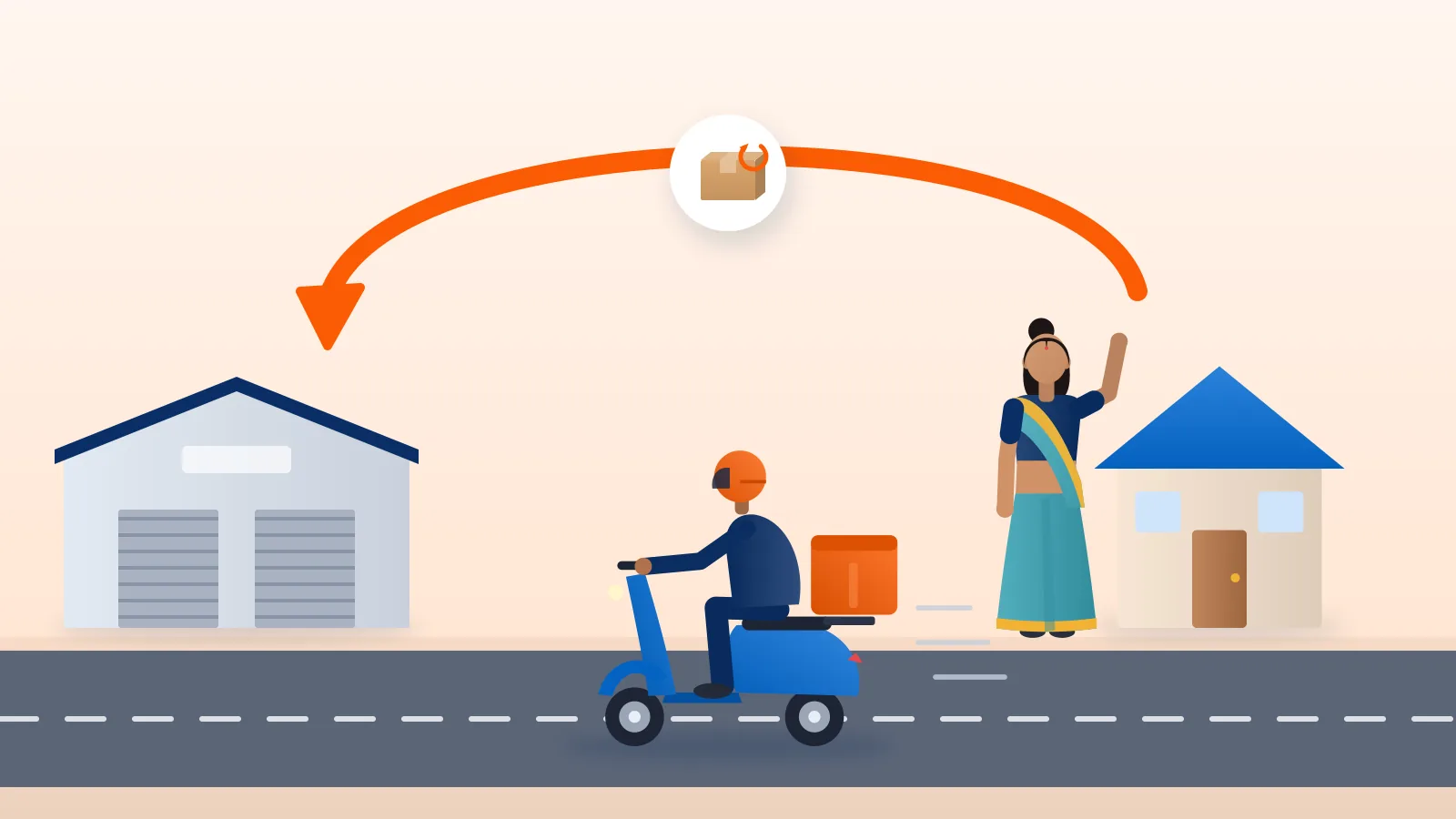
A buyer in Coimbatore orders a pair of running shoes, they arrive a size too small, and she asks for a return. She does not want to queue at a courier counter, and you would not want her to: the more effort a return takes, the angrier the buyer gets and the slower the product comes back to you. So you book a courier to collect the shoes from her door. That collection is a reverse pickup.
This guide explains what a reverse pickup is, how it differs from an RTO and an exchange, what happens step by step, and why some pickups fail. It is written for sellers who are starting to receive returns and want to handle them without confusion. The wider question of how to design a returns policy and keep its cost under control is covered in our guide to reverse logistics and returns cost control.
Reverse pickup meaning, in one paragraph
A reverse pickup is a shipment that runs the opposite way to a normal order. The pickup point is the buyer’s address, the delivery point is your return address (your home, shop or warehouse), and the seller books and pays for it. Couriers sometimes call it a reverse shipment, an RVP or a DTO (direct to origin). The parcel gets its own tracking number, separate from the original forward AWB, so you can follow it like any other shipment.
Reverse pickup vs RTO vs exchange
Sellers often mix these up, and the confusion shows up in reports and reconciliation. The difference is simple once you see it side by side.
| Reverse pickup | RTO (return to origin) | Exchange | |
|---|---|---|---|
| Was the order delivered? | Yes | No | Yes |
| Who starts it? | Buyer requests, seller books | Courier, after failed attempts or refusal | Buyer requests, seller approves |
| Where does it start? | Buyer’s address | Courier’s network, after the failed delivery | Buyer’s address |
| Typical reasons | Wrong size, damaged, not as described, changed mind | Buyer not reachable, refused, wrong address, COD not ready | Size or colour swap |
| What the seller ships out | Nothing, or a refund | Nothing | A replacement (new forward shipment) |
An RTO is a delivery failure; a reverse pickup is a post-delivery return. If you want to reduce RTOs, the work happens before and during delivery, which our RTO reduction playbook and the guide to NDR and RTO meanings cover. Reverse pickups are reduced mainly by better product information and packing, which we come to below.
An exchange usually involves two shipments: a reverse pickup for the old item and a forward shipment for the new one. Some sellers send the replacement only after the old item reaches them; others send both together for trusted buyers. Either way, each leg is a separate booking with its own AWB.
How a reverse pickup works, step by step
The exact screens differ between couriers and platforms, but the flow is broadly the same everywhere.
- The buyer asks for a return. This comes through your website’s return form, a marketplace, WhatsApp or email. You note the reason and, if your policy asks for it, photos.
- You approve the return. Check it against your policy: is it within the return window, is the product category returnable, is the reason valid?
- You check serviceability. Not every courier collects from every pincode, and reverse coverage can be narrower than forward coverage. Confirm the buyer’s pincode is covered for reverse pickup before you tell the buyer a pickup is coming.
- You create the reverse shipment. You enter the buyer’s address as the pickup point, your return address as the destination, and the package weight and dimensions. Delhivery’s help centre, for example, describes two routes: starting a return from an already delivered order, or creating a reverse order manually with the item, customer, return location, box size and weight.
- The buyer is told when to expect the executive. A message with the pickup date and the return tracking reference saves a lot of failed visits.
- The executive collects the parcel. The parcel is scanned and enters the courier network.
- It travels to your return address and is delivered. Delhivery’s help centre lists the reverse statuses as Ready for Pickup, In Transit, Out for Delivery and Delivered, which mirrors a normal shipment.
- You inspect and close the return. You check the product, then refund, exchange or reject according to your policy.
Steps 1 to 3 are where most mistakes happen, because they happen before any courier is involved.
Why reverse pickups fail
A reverse pickup that does not happen costs you twice: the buyer is annoyed, and you may still be charged for the attempt depending on your courier’s terms. The common causes:
- The buyer is not available or not answering the phone when the executive calls.
- The product is not packed. The buyer expected the executive to bring a box.
- The buyer has changed their mind and no longer wants to return, but nobody cancelled the pickup.
- The pincode is not covered for reverse service, or the address is incomplete.
- The parcel does not match the booking. A box much larger or heavier than declared may be refused or re-weighed.
- Disagreement at the door. The buyer hands over a different item, or something is missing, and the executive or the buyer is unsure what to do.
Most of these are communication problems. A short message before pickup day fixes many of them: “Your return pickup is booked for Thursday. Please pack the shoes in the original box with the tags on and keep your phone on.” Our guide to the buyer-facing returns experience has templates for each stage.
The last point, checking the item at the door, is a separate practice called doorstep quality check. Whether it is offered depends on the courier and the account. Our guide to quality checks on reverse pickups explains how it works across the industry and what to do without it.
What a reverse pickup costs you
A return costs you money even when the buyer pays nothing. You typically bear:
- the forward shipping you already paid, which you rarely recover;
- the reverse shipping charge, which couriers price separately from forward shipments;
- any COD-related charges on the original order, if it was COD;
- packing material and staff time to inspect and restock;
- the value lost if the product cannot be sold again as new.
Couriers bill reverse shipments on chargeable weight, just like forward ones: the higher of the actual weight and the volumetric weight worked out from the box size. A buyer who returns a small item in a large carton can push the charge up. Asking buyers to reuse your original packaging helps. See how volumetric weight affects charges for the formula.
Reverse pickup or buyer drop-off?
You do not have to offer doorstep pickup for every return. A simple way to decide:
| Situation | Doorstep reverse pickup | Buyer ships it back |
|---|---|---|
| Wrong, damaged or defective item (your error) | Yes; the buyer should not pay or travel | No |
| Change-of-mind return, high-value item | Usually yes, to protect the item in transit | Possible, with tracking |
| Change-of-mind return, low-value item | Weigh the reverse charge against the item value | Often more economical |
| Buyer’s pincode not covered for reverse | Not possible | Yes, with your return address and instructions |
Some sellers also offer a “keep it” refund for very low-value items where the reverse charge would exceed what the product is worth. That is a business call, but it is worth running the numbers before booking a pickup for a ₹199 item.
Reverse pickups with Courier Tales
On Courier Tales you can book reverse pickups from the buyer’s address with Delhivery in eligible pincodes. Check the buyer’s pincode before you promise a pickup; if it is not eligible, give the buyer your return address and ask them to ship it back with tracking. The returned parcel is tracked in the same dashboard as your forward shipments, and you can raise a support ticket on any shipment if something goes wrong.
Getting your first returns? Book reverse pickups from the buyer’s door with Delhivery in eligible pincodes and track them alongside your other shipments.
Checklist before you book a reverse pickup
- Return approved against your written policy, with the reason recorded
- Photos from the buyer for damage or “wrong item” claims
- Buyer’s pincode checked for reverse pickup service
- Full address and a working phone number confirmed
- Weight and box size entered realistically
- Buyer told the pickup date, how to pack, and what to hand over
- Original order number noted on the reverse shipment, so the return matches the sale in your records
- A plan for what happens if the pickup fails: one rescheduled attempt, then a call
Final thoughts
A reverse pickup is just a shipment pointed the other way, but it carries more emotion than a normal delivery. The buyer is already disappointed, and every missed visit makes it worse. Clear approval rules, a serviceability check and one well-timed message before pickup day get most returns back to you smoothly, and give you a chance to win the buyer’s next order.
When your returns start to become regular, keep them in the same place as the rest of your shipping. Create your Courier Tales account to book shipments, arrange reverse pickups in eligible pincodes and track every parcel from one dashboard.
Frequently asked questions
What is reverse pickup in ecommerce?
It is a courier collection from the buyer's address that brings a delivered product back to the seller. The seller books it, and a pickup executive collects the parcel from the buyer instead of the buyer dropping it off. It is the usual way online returns and exchanges are collected in India.
Is reverse pickup the same as RTO?
No. RTO (return to origin) happens when a parcel is never delivered, for example because the buyer refused it or was not reachable. A reverse pickup happens after a successful delivery, when the buyer wants to send the product back.
Who pays for a reverse pickup?
The courier bills the seller, or the seller's shipping platform, for the reverse shipment. Whether the seller passes that cost to the buyer is a policy decision. Many sellers absorb it for damaged or wrong items and recover it, fully or partly, for change-of-mind returns.
Is reverse pickup available at every pincode?
No. Couriers offer reverse pickups only in the pincodes they serve for that service, and the list can be shorter than for forward deliveries. Check serviceability for the buyer's pincode before you promise a doorstep collection.
What should the buyer do before the pickup executive arrives?
Keep the product packed securely, ideally in its original box with tags and accessories, and stay reachable on the phone number given in the order. If the seller has asked for photos or a return form, have them ready.
Sources
- B2C Reverse Pickups/DTO, Delhivery Help Centre (accessed 2 November 2026)
Courier, marketplace and tax rules change. Check the current terms with your courier, marketplace or adviser before relying on them.