
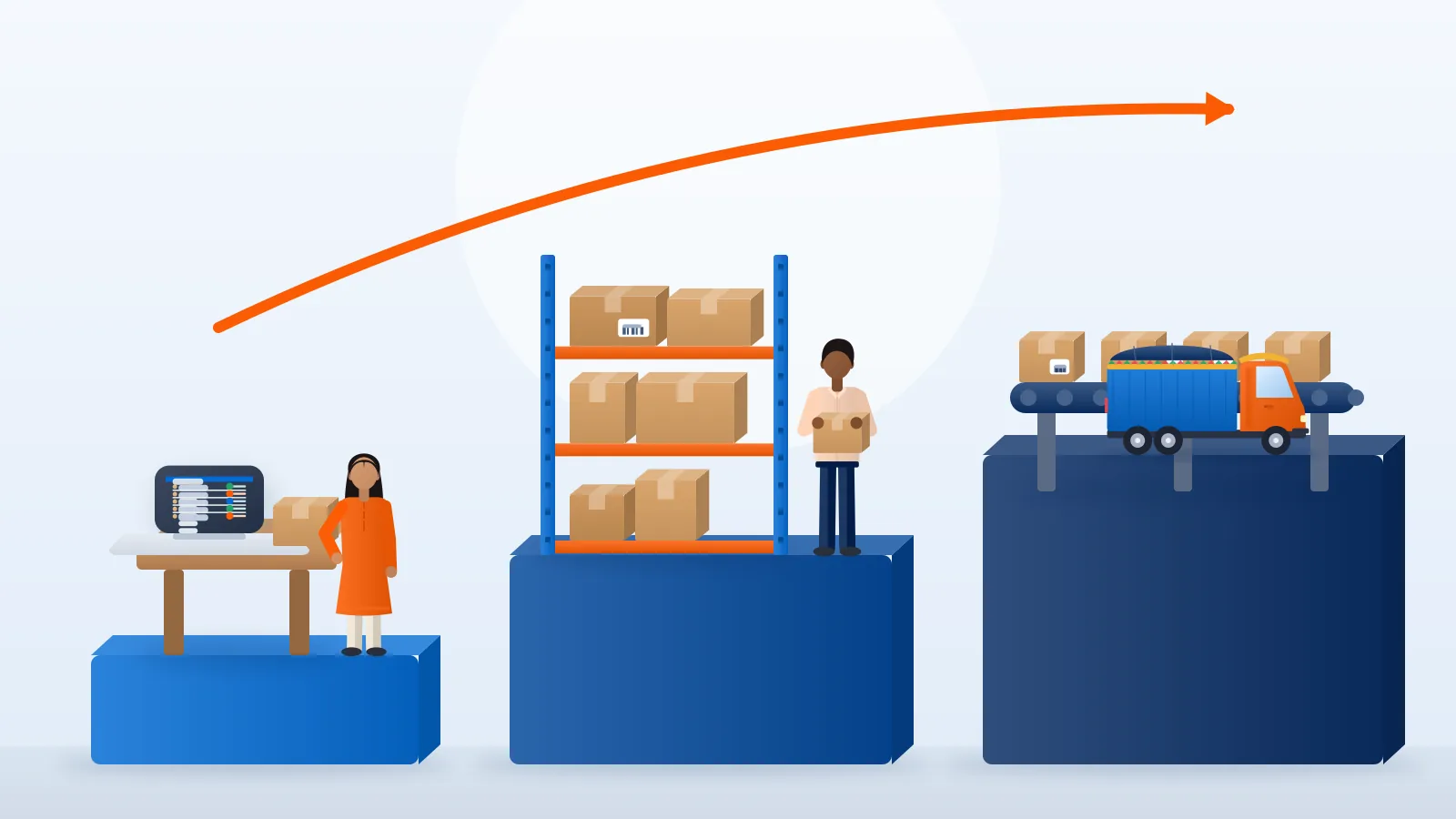
Going from 10 orders a day to 1,000 is not the same job done a hundred times faster. At each stage something that worked well becomes the thing that breaks: the spreadsheet, the dining-table packing station, the founder answering every WhatsApp message, the cash in the bank.
This guide walks through the stages most Indian online sellers pass through, what usually breaks at each one, and what to put in place before it does. The order numbers are rough markers, not rules. A seller of heavy furniture will hit these problems at much lower volumes than a seller of phone cases.
The four stages at a glance
| ~10/day | ~50/day | ~200/day | ~1,000/day | |
|---|---|---|---|---|
| Where you pack | Home | Spare room or small unit | Rented unit with racks | Warehouse with zones |
| Team | Founder | Founder + 1–2 packers | Small ops team with a lead | Shifts, supervisors, separate support |
| Order flow | Manual or one store | Store import + bulk upload | Multiple channels, bulk booking | Automated import, rules, API |
| Main risk | Mistakes in each order | Founder’s time | Errors at volume, stock mismatch | Cash tied up, process drift |
Stage 1: around 10 orders a day
At this volume the founder does everything. That is fine, and it is the right time to set habits that will matter later.
Operations. Set up one packing table with a weighing scale, two or three standard box sizes and labelled stock. Weigh every parcel. If you guess weights now, you will be guessing at 200 a day too.
Systems. Use a store platform or a shipping platform that keeps all orders in one place, even if you only have one channel. A notebook of orders becomes a problem the day you are sick.
Cash. Know your profit per order after product, packaging, shipping, payment charges and returns. Include the costs that only show up later, such as COD charges and the return trip on parcels that come back.
What to fix before stage 2: write down your packing steps, and keep a simple log of returns with the reason for each.
Stage 2: around 50 orders a day
This is usually when founders feel the pressure first. Packing and booking take most of the day, and there is no time left to source products or market them.
Operations
- Move stock out of living space. A spare room with shelving or a small rented unit is usually enough.
- Give every product a fixed shelf location and a short code (SKU). Packers should find items by location, not by memory.
- Fix a daily cut-off: orders received before, say, 1 pm go out with today’s pickup. Buyers and couriers both benefit from a predictable rhythm.
Team
Hire your first packer. Give them a printed checklist: pick, check item against order, pack in the listed box size, weigh, label, place in the pickup area. Check a few of their parcels each day for the first month.
Systems
Stop booking orders one by one. If you sell on Shopify or WooCommerce, connect the store so orders import automatically. For orders from marketplaces or social media, upload them in bulk from a spreadsheet. Book and print labels in one batch.
Cash
At 50 orders a day, stock purchases become large enough to hurt if a product stops selling. Reorder in smaller batches more often, and track which SKUs sell through within a month.
What to fix before stage 3: a stock count you trust, and a process that works on days you are not there.
Stage 3: around 200 orders a day
Volume now exposes every small error. A 2% mistake rate that meant one wrong parcel a day at 50 orders means several at 200, and each one costs a return trip, a refund or a complaint.
Operations
- Split the work into stations: picking, packing, weighing and labelling, dispatch. One person per station is faster than everyone doing everything.
- Print pick lists grouped by product, so a packer collects ten of the same item at once instead of walking back to the shelf ten times.
- Prepare pickup manifests and hand parcels over against them. Disputes about “missing” parcels are much easier to settle with a signed manifest.
Team
Appoint an operations lead who owns the daily dispatch, not the founder. Separate customer support from packing, even if it is one person for each, so that phone calls do not stop the packing line.
Systems
This is the stage where using more than one courier tends to pay off, because no single courier serves every pincode equally well. Set rules rather than choosing a courier for each order by hand. Our guide on why sellers move to a multi-courier platform covers the signs.
On Courier Tales you can set a courier priority for your account, see the integrated couriers that serve each route with estimated charges, and book many orders at once.
Booking hundreds of orders a day? Import orders from your store or a spreadsheet, book them in bulk with your courier priority, and print labels and manifests in one go.
Cash
Watch three numbers every week: cash in the bank, value of stock on hand, and money owed to you (COD not yet remitted, marketplace settlements pending). Many profitable sellers run short of cash at this stage because orders grow faster than settlements.
What to fix before stage 4: a written process for failed deliveries and returns, and a weekly cash forecast.
Stage 4: around 1,000 orders a day
At this volume you are running a small logistics operation, whatever you call your business.
Operations
- Lay out the warehouse in zones: inward, storage, picking, packing, dispatch, returns. Returns need their own area and their own person, or they pile up and stock counts drift.
- Stagger pickups if your couriers allow it, so the dispatch area does not overflow at one hour.
- Track daily: orders received, orders shipped, orders pending past the cut-off, and the reason for each pending order.
Our guide on managing high-volume shipments goes deeper on running 500 to 1,000 shipments a day.
Team
Work in shifts if order volume demands it, with a supervisor on each shift. Write standard operating procedures (SOPs) for every station and review them each quarter. New people should be productive in days, not weeks.
Systems
Manual steps are now your biggest cost. Automate what you can: order import, courier selection rules, label printing, tracking messages to buyers. Developers can connect their own systems to Courier Tales through the API, and our guide on automating ecommerce shipping explains the options.
Keep an eye on the exceptions too. At 1,000 parcels a day, failed deliveries and weight discrepancies arrive daily. Someone must own the NDR list and work through it every morning. On Courier Tales, weight disputes appear in the dashboard and you have 48 hours to respond with evidence, so photographs of weighed parcels need to be part of the packing process, not something you hunt for later.
Cash
This is where cash planning matters most. Here is an illustration with round numbers, not a forecast:
| Figure | |
|---|---|
| COD orders per day | 600 |
| Average COD order value | ₹800 |
| COD value shipped per day | ₹4,80,000 |
| Days until COD is remitted after delivery (D+7 default on Courier Tales) | 7 |
| Plus average days in transit | 4 |
| Approximate COD cash outstanding at any time | ₹4,80,000 × 11 ≈ ₹52,80,000 |
That is money you have already spent on stock, packing and shipping. Grow COD orders by 20% and the amount outstanding grows with it. Our guide to COD settlement and cash flow works through a full cash cycle.
Ways to reduce the gap include shifting more buyers to prepaid, choosing a faster COD remittance plan where the fee makes sense, and using COD money to recharge your shipping wallet so you are not topping it up from the bank.
Mistakes sellers make while scaling
- Hiring before writing the process down. New people copy whatever they see, including mistakes.
- Adding channels faster than operations can handle. A new marketplace brings new rules, new dispatch deadlines and new return flows. Our guide on multichannel order management explains how to keep them in one place.
- Ignoring returns until they pile up. Unprocessed returns hide stock you could sell and refunds you owe.
- Not checking courier performance by lane. Average delivery times hide the routes where one courier struggles.
- Running out of cash while profitable. Profit on paper does not pay rent if it is stuck in settlements.
Final thoughts
Scaling an online business is mostly about removing yourself from the daily work in the right order: first from packing, then from booking, then from exceptions, and finally from deciding how each order ships. Each step needs a written process, a person who owns it, and a system that does the repetitive part.
Create your Courier Tales account to bring your orders, couriers, labels and tracking into one dashboard as you grow.
Frequently asked questions
At what order volume should I move out of my home into a warehouse?
There is no fixed number. The usual signs are stock spilling into living space, packing taking more than a few hours a day, and pickups being missed because parcels are not ready. Many sellers move to a small rented unit first rather than a large warehouse.
When should I hire my first employee?
Hire when one task is clearly taking time you should spend on selling or sourcing. For most sellers that is packing and dispatch. Write the steps down before the person joins so they can learn from a checklist rather than by watching you.
Why does cash get tighter as orders grow?
You pay for stock, packaging, shipping and marketing before you are paid for the order, especially on COD and marketplace orders. The more orders you ship each day, the more money sits between paying out and getting paid. Planning for that gap is part of scaling.
Do I need custom software to handle 1,000 orders a day?
Not necessarily. Many sellers at that volume use their store platform, a shipping platform with bulk booking and an accounting tool, connected through imports or an API. Custom software makes sense when your process is unusual or your tools cannot talk to each other.